EUR/US$ 1.1535
Cotton Rallies from Early Weakness to Close Higher on Monday
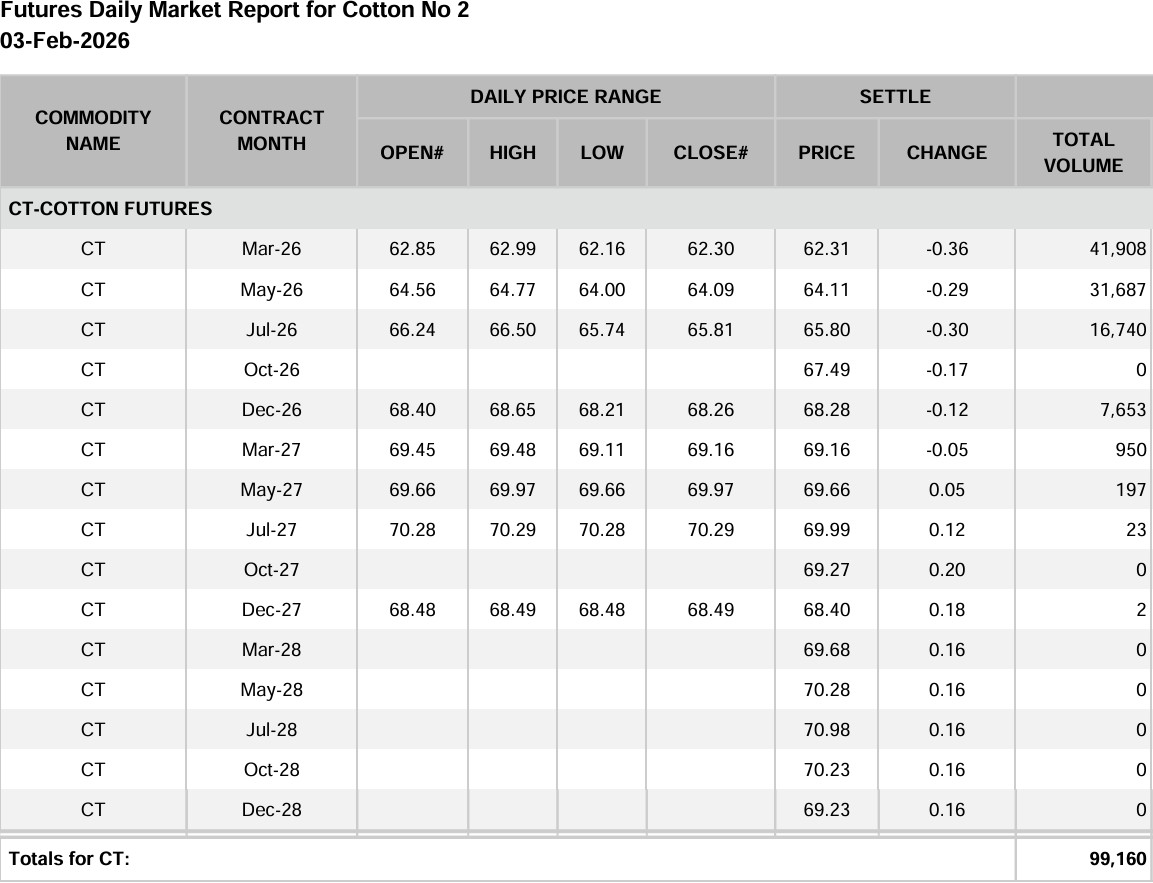
Barchart: Cotton futures closed Monday with gains of 36 to 85 points across the board, recovering from early weakness. Crude oil fell $4.61 per barrel, while the US dollar index rose $0.61. Monday's Crop Progress report showed 88% of the U.S. crop squared as of Sunday, now level with the five-year average, with 55% setting bolls and 4% with open bolls. The good-to-excellent condition rating slipped to 42%, down 4 points on the week. The Brugler500 index fell 11 points to 325. The Cotlook A Index rose 125 points on Friday to 90 cents, while ICE certified stocks fell 3,093 bales on July 31 via decertification to 87,606 bales. The Adjusted World Price was raised 84 points last week to 64.66 cents/lb. December cotton closed at 82.57, up 78 points.
Source: Barchart
Cotton QuickTake — Week of August 3, 2026
PCCA: The week ahead centers on crop conditions, export demand, and next week's August USDA supply and demand report, with Friday's employment report the main macro release. Rain across parts of West Texas and Oklahoma offered some relief from last week's heat, though coverage was uneven and hotter weather is expected to return. Last week, December futures settled at 81.79 cents/lb, up 181 points, supported by stronger export sales, another sold-out Chinese reserve auction, and a weaker dollar, though prices again struggled near 82-cent resistance. The Federal Reserve held rates steady at 3.50%-3.75%. Upland export sales hit a marketing-year low of 29,700 bales, while new-crop sales reached 352,400 bales, one of the strongest weeks on record. With one reporting week left in 2025/26, focus is shifting to whether U.S. exports reach USDA's 12.2 million bale target.
Source: PCCA
World Cotton Trade to Reach 10.3m Tonnes by 2028/29
Just-Style (ICAC 2026 World Cotton Trade Report): Global cotton trade is projected to grow from 9.4 million tonnes in 2025/26 to about 10.3 million tonnes by 2028/29, even as world production is set to fall 2% to 25.8 million tonnes in 2026/27 while consumption holds near 25.5 million tonnes. Brazil is expected to remain the top exporter in 2025/26 on strong harvests and competitive pricing, even as reduced US availability pushes buyers elsewhere; US exports, which dipped in 2025/26, are seen rebounding 3% next season. China's imports are expected to rise sharply as demand recovers, while Vietnam continues gaining importance as an importer and Bangladesh's consumption remains pressured by economic and energy challenges. ICAC flags tariff policy shifts, high energy costs, and shipping risks around the Strait of Hormuz as key uncertainties, with narrowing supply-demand gaps making exporters' inventories increasingly critical.
Source: Just-Style
China Warns of Crop Risks as Heat Sweeps Agricultural Regions
Bloomberg: China's corn, rice and cotton crops face heightened risk of damage as a heat wave moves through key agricultural regions in the north and east. Forecaster Vaisala expects high-pressure systems to bring hotter-than-normal conditions this week, with Shenyang in Liaoning province seeing highs of 35-38°C through Thursday and Beijing reaching the low-to-mid 30s°C into the weekend.
Source: The Straits Times
How Will the New U.S. Additional Tariffs Affect Turkish Textile Industry?
Textilegence: Under Section 301, the U.S. has imposed new tariffs of 10-12.5% on imports from 60 trading partners over inadequate forced-labor enforcement, with Türkiye facing the higher 12.5% rate. Competitors Bangladesh and Cambodia face only 10%, and along with Indonesia and Malaysia can access a tariff-rate quota exempting certain textile exports from the Section 301 duty if they use U.S.-origin cotton or textile inputs, starting no earlier than September 1, 2026. Istanbul Chamber of Industry Chair Erdal Bahçıvan called the arrangement unfair, warning total customs duties on Turkish textile, apparel and garment products could rise to 25-30%, since Türkiye lacks the tariff ceiling granted to the EU, Japan, South Korea and Switzerland. Turkish textile exports to the U.S. grew 14% year-on-year to $409 million in H1 2026, making it Türkiye's second-largest textile export market. Industry figures are calling for Türkiye to be included in the duty-free quota system through upcoming bilateral talks.
Source: Textilegence
Sanko Group Eyes $300m Textile Manufacturing Shift into Bangladesh
Ecotextile News: Turkey's Sanko Group is planning a $300 million investment in a modernised integrated fabric manufacturing facility in Bangladesh's Mirsarai industrial zone, aiming to shift from Turkey-based supply to a full-scale local production base. The company has begun preliminary site selection and talks with local partners; the plant would handle fabric production, advanced processing and higher-value export-oriented textile output. Mirsarai is being developed as a major industrial hub with tax incentives to attract investors. The move follows pressure on Turkish textile firms from high inflation and rising costs, pushing some manufacturers to relocate production abroad for cheaper, export-oriented output.
Source: Ecotextile News
Demand Stalls in Cotton Above 80 Cents
Agronews (Giannis Papadogiannis): The 78-82 cent/lb range continues to hold for December '26 futures, with mills buying near the lower end of that range and hesitating at the top. On the positive side, China has begun successfully selling part of its state reserves. New U.S. tariffs, along with a broader commodities pullback driven by ceasefire hopes, added further pressure on cotton. In the Greek market, physical demand nearly stalls whenever futures reach 81-82 cents, since spinners can't operate with adequate margins at that level. Advance sales for the new crop remain limited — around 15% of estimated production, below the average of previous years — as growers hold out for higher premiums, a pattern the author warns could pressure premiums once large volumes come to market in autumn.
Source: Agronews