
EUR/US$: 1.1545
Cotton Fading Lower on Wednesday, as USDA Hikes Acreage
Barchart: Cotton futures gained 8 to 48 points across most contracts on Wednesday, with December the lone exception, down a tick, after the market digested the day's USDA reports. Crude oil eased 62 cents a barrel and the dollar index firmed. USDA's Crop Production report trimmed the 2026 US cotton crop by just 90,000 bales to 13.61 million, even as planted area was raised 0.62 million acres to 10.47 million; the increase in acres was more than offset by a lower national yield estimate, cut 74 lbs to 798 lbs per harvested acre. Old-crop (2025/26) ending stocks were left unchanged at 4.2 million bales, while new-crop (2026/27) stocks were trimmed 100,000 bales to 4 million. The Seam reported a small sale at 75.24 cents, the Cotlook A Index eased 50 points to 94.45 cents, ICE certified stocks fell nearly 1,800 bales, and the Adjusted World Price held last week's 163-point increase at 66.29 cents/lb. December cotton settled essentially flat at 84.38 cents.
Source: Barchart
Calcot Market Comment – August 12, 2026
Calcot: Cotton futures were nearly higher across the board Wednesday, but December settled a point lower at 84.38 cents, leaving it down 2 points for the week after touching an intraday high of 85.25 cents, its best level since mid-May. Volume was 55,196 contracts. Today's WASDE report and the first state-by-state 2026 production estimates, released at noon, triggered a sell-off that only partly reversed; the numbers weren't outright bearish but fell short of more bullish expectations. USDA cut 2026/27 world ending stocks by 1.539 million bales to 69.685 million, the lowest since 2011/12, and lowered US ending stocks 100,000 bales to 4.0 million. World production was raised 373,000 bales to 117.632 million but remains over 4 million bales below 2025/26, while world consumption was raised 965,000 bales to 122.918 million. Open interest rose for an eighth straight session to 349,370 contracts, with specs likely net buyers and trade net sellers as growers keep selling into the rally. China's state reserve completed its 18th consecutive sold-out auction, moving about 8,003 tonnes and bringing the 18-day total to roughly 634,900 bales, about 49% US, 19% Brazilian and 32% Xinjiang cotton. US July CPI came in as expected at +0.1% month-on-month, with the annual rate easing to 3.4%, reinforcing expectations the Fed will hold rates steady next month; equities were mixed while grains surged, led by corn and wheat, and crude oil added only a few cents amid stalled US-Iran talks.
Source: Calcot
USDA WASDE – August 2026: Cotton
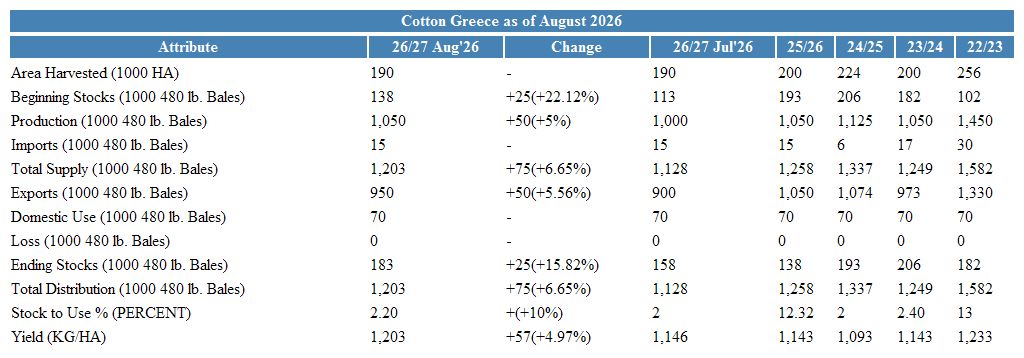
USDA WASDE: The August report set the US 2026/27 cotton production estimate at 13.61 million bales based on the new Crop Production survey, over 90,000 bales below July's forecast and nearly 300,000 bales smaller than 2025/26. Planted area was raised over 600,000 acres to 10.47 million, but a national yield cut to 798 lbs per acre (down 74 lbs) left the crop smaller overall; projected ending stocks were lowered to 4.00 million bales, a 28.8% stocks-to-use ratio, while the season-average farm price was raised 2 cents to 75 cents/lb. The 2025/26 balance sheet was left unchanged, though that season's average price was trimmed a cent to 61.5 cents/lb. Globally, 2026/27 production was raised over 370,000 bales to 117.6 million, as larger crops in Brazil, Greece and Turkey outweighed the smaller US crop, while consumption was raised nearly 1 million bales to 122.9 million on stronger demand from China, India, Vietnam and Indonesia. With trade also revised higher, world ending stocks for 2026/27 were cut by more than 1.5 million bales to 69.7 million, a 56.7% stocks-to-use ratio, the tightest since 2011/12.
Source: USDA WASDE
Cotton Spinning Mills Struggling to Avoid Losses
Textile Today: The piece lays out why Bangladesh's cotton-spinning industry, despite running more than 16 million spindles and underpinning the country's position as the world's second-largest garment exporter, struggles with structural cost disadvantages against regional rivals. Unlike India, China or Pakistan, which spin their own domestically grown cotton, Bangladeshi mills must import all their cotton in dollars, hold roughly six months of inventory, and absorb higher transport, financing and energy costs, adding an estimated 8% to unit yarn-production costs. Combined with destocking and pricing pressure across the global fashion industry since the war in Ukraine, the sector is described as losing 40 to 50 cents per unit, raising doubts about how long spinners can keep absorbing losses without jeopardizing the wider garment-export chain, which itself depends on a reliable domestic yarn supply.
Source: Textile Today
Inside the $5 Billion Plan to Keep Africa's Cotton Jobs in Africa
Financial Fortune Media: West Africa's main cotton producers, the C4+ group of Benin, Burkina Faso, Chad and Mali, with Côte d'Ivoire as an observer, are backing a roughly $5 billion, decade-long plan to build regional spinning, weaving and garment capacity so more of the value from their cotton stays on the continent; today about 98% of the region's cotton leaves as raw fiber, and Africa accounts for 7 to 10% of global cotton production but under 2% of global textile and clothing exports. The plan, known as the Partenariat pour le Coton, aims to knit producing countries into a single "Textile Corridor," pooling supply chains and building modern ginning, spinning and sewing capacity near transport routes, backed by the WTO, UNIDO, Afreximbank and other partners; officials say it could create around 500,000 direct jobs. A parallel WTO-FIFA partnership aims to generate early demand by sourcing sportswear for football programs from the new regional manufacturing base. Backers acknowledge that rules of origin under the African Continental Free Trade Area will be critical to ensuring finished goods actually qualify as African-made, and that the experience of existing industrial parks such as Ethiopia's Hawassa, where many garment workers have been found to earn below a living wage, shows job quality will matter as much as job numbers.
Source: Financial Fortune Media
Global Cotton Mill Use at a Six-Year High
Oklahoma Farm Report (Southern Ag Today): World cotton mill use is projected at 121.95 million bales for 2026/27, up about 2 million bales from 2025/26 and the highest since 2017/18, marking a fourth straight year of growth. The gains are concentrated in a handful of countries: China's mill use is forecast at 41.5 million bales, the highest since 2020, while India's is projected at 26 million bales, matching the record set in 2020/21; together China and India are expected to account for 55% of global mill use. Pakistan is projected to mill 10.2 million bales and Bangladesh 7.8 million, both up on the year, while US mill use remains a fraction of these totals at 1.6 million bales, down from 2.5 million in 2021. Drivers include steady consumer demand for cotton apparel, cotton's improved price competitiveness against oil-linked synthetic fibers, and mills restocking thin yarn and fabric inventories. Combined with tighter production this year, the pickup in demand is projected to pull world ending stocks down to 71.1 million bales, the lowest since 2018/19, supporting the higher season-average farm price USDA has been projecting.
Source: Oklahoma Farm Report
India's Cotton Stocks Hit Record 93.59 Lakh Bales
Apparel Resources: India's opening cotton stocks for the 2026/27 crop year (starting October) are now estimated at a record 9.359 million bales of 170 kg each, up 68% year-on-year and 3.8 million bales above the prior year, according to the Cotton Association of India (CAI). The jump is driven mainly by record imports, expected to reach 6.2 million bales this season, up from a more typical 1.5-2 million bales in past decades and 4.1 million bales last year; about 5.4 million bales had already been imported by end-July, with another 800,000 expected by September. CAI also raised its 2025/26 production estimate by 200,000 bales to 33.9 million, following a 300,000-bale increase the previous month, while keeping domestic consumption unchanged at 34.8 million bales and trimming the export estimate to 1.5 million bales from 1.8 million a year earlier. Cotton imports remain duty-free through October 31, and CAI's Atul Ganatra attributed the stock build mainly to two years of elevated imports; domestic prices are firm, with Cotton Corporation of India's selling price up 200 rupees per 356-kg candy on August 11, and the outlook for spinning mills stays mixed as improved raw-material availability meets weak downstream demand.
Source: Apparel Resources