
EUR/US$: 1.16795
Cotton Closes Steady on Friday
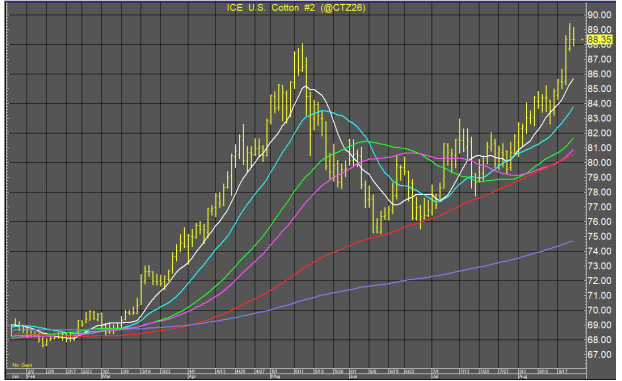
Barchart: Cotton futures were little changed on Friday, up 0.01 to 0.07 cents in the front months, with December closing at 88.35 cents, tying its contract-high settlement. December finished the week up 3.55 cents. Managed money added another 5,798 contracts to their net long position in the week ending August 18, taking it to 78,668 contracts. Export Sales data put 2026/27 export commitments at 4.235 million bales, up 31% from last year but still just 37% of the USDA's export projection. The Cotlook A Index jumped 3.00 to 98.90 cents on August 20.
Source: Barchart
Calcot Market Comment – August 21, 2026
Calcot: Cotton futures marked time near contract-high levels Friday, with December settling at 88.35 cents, up just a point but tying its own record close set Wednesday; five other contracts also posted contract-high settlements. It was December's seventh higher weekly close in the last eight weeks, a net gain of 1,197 points (15.7%) since June 26. Open interest rose for a 15th straight session and began the day at 368,084 contracts, the ninth-highest level in cotton's history. Friday's CFTC data showed speculators net buying and the trade net selling for a third straight week; specs have been net buyers in six of the last seven weeks. China's state reserve completed its 25th consecutive sold-out auction, taking the 25-day cumulative total to roughly 882,400 bales, about 47% US, 21% Brazilian and 32% Xinjiang cotton. Crude oil has risen in 11 of the last 12 sessions on continued Strait of Hormuz disruption, and markets now turn to next week's Jackson Hole symposium for guidance on Fed policy.
Source: Calcot
Cotton Market Summary as of Friday, August 21, 2026
TAMU (Dr. John Robinson): ICE cotton futures climbed about four cents this week before appearing to peak Friday, with December settling at 88.35 cents and new-crop December '27 at 80.26 cents. Chinese cotton prices and the world A-Index mostly rose. Squaring, boll-setting and boll-opening rates were near their five-year averages through August 16, but the overall crop condition slipped further to 38% good-to-excellent with 36% fair; Texas stayed mostly hot and dry, and northwestern Texas continues to see damage from dryness and heat. Current-marketing-year export sales were fair at 209,400 bales for the week ending August 13, and weekly shipments ran just below the USDA's target. Open interest rose steadily through the week, and CFTC data through August 18 showed hedge funds adding 3,828 net long positions.
Source: The Cotton Marketing Planner (TAMU)
EURATEX and CITI Launch EU-India Textile and Apparel Dialogue
EURATEX: EURATEX and India's Confederation of Indian Textile Industry (CITI) have launched a new EU-India Textile and Apparel Dialogue, signed in New Delhi to support balanced implementation of the EU-India Free Trade Agreement. The platform, with equal representation from both sides and a rotating annual chairmanship, will meet twice a year to discuss customs procedures, rules of origin, market access barriers and fair competition, and to share good practice on traceability and sustainability. It aims to help companies, including smaller ones with less trade experience, make practical use of the agreement, and may issue joint recommendations to the European Commission and the Indian government.
Source: EURATEX
China Cotton Imports: Australian Cotton Becomes the Top in July 2026
CCFGroup (Dilys Wang): China's cotton imports rose to 91,600 tonnes in July, up 38,500 tonnes year-on-year, taking the first seven months of 2026 to just over 1.03 million tonnes, double last year's pace. Australia was the top supplier with 54,800 tonnes (60% share), followed by Brazil and the US, whose share fell to just 7%. CCFGroup expects imports to hold steady or edge higher in August, with Australia likely remaining the top source.
Source: CCFGroup
China Has Tripled Cotton Purchases From India. Where Does Pakistan Fit In?
Profit by Pakistan Today: China's cotton yarn purchases from India have nearly tripled in ten months, with India's share of Chinese yarn imports rising from 7% to 21%, largely at Pakistan's expense, per the latest USDA data. The shift reflects temporary factors — Iran-conflict supply disruption, tight Chinese cotton supply, a weaker rupee and well-placed Gujarat mills — rather than a lasting change. The piece argues it exposes a deeper problem: Pakistan's cotton output has roughly halved since the mid-2000s, forcing mills to import cotton and leaving the country stuck exporting low-value yarn rather than finished garments, unlike Bangladesh and Vietnam. It concludes Pakistan needs credible cotton-support policy plus industrial reforms to be ready next time demand shifts.
Source: Profit by Pakistan Today
Ethical Sourcing Boosting Demand for Tanzania Organic Cotton
The Exchange Africa (Giza Mdoe): The Tanzania Cotton Board wants to raise average cotton yields five-fold, from about 200 to 1,000 kg per acre, as the country's 2025/26 output is forecast to rebound 48% to roughly 222,000 tonnes. Tanzania is already Africa's largest organic cotton producer, and rising demand for ethically sourced fibre from global fashion brands is boosting interest in its crop, led by the Simiyu region. The board is running nationwide farmer training on practices like proper fertilizer use and hybrid seed, and says it is working with buyers to guarantee a market at competitive prices. Cotton is Tanzania's largest export crop after coffee, generating an estimated $83-90 million a year, though officials note climate change poses a growing risk.
Source: The Exchange Africa