EUR/US$: 1.1664
Cotton Rally into Monday's Close as USDA Cuts Ratings
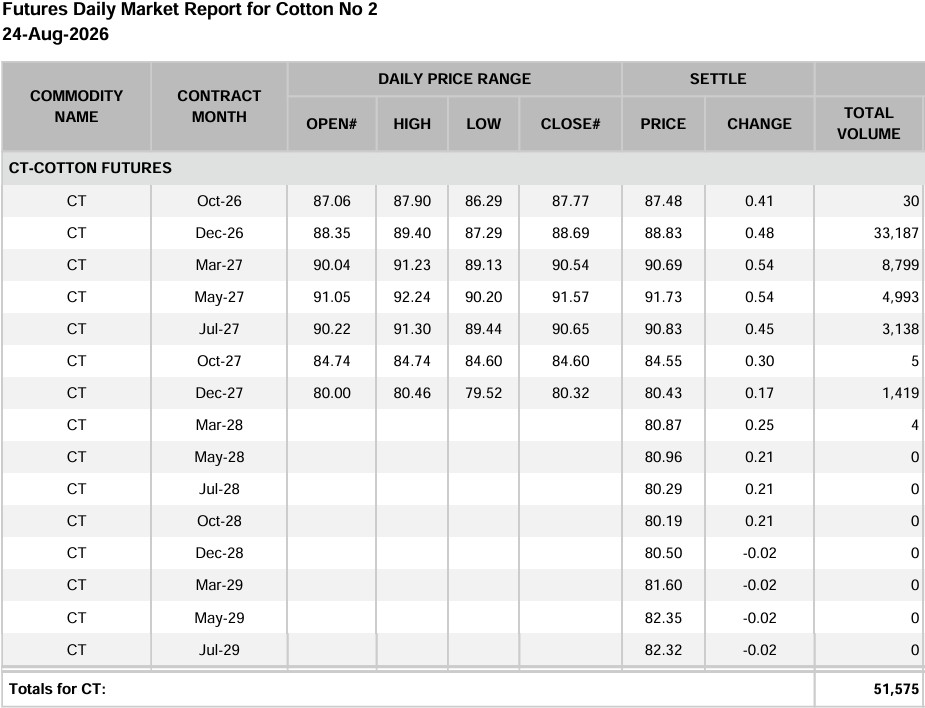
Barchart: Cotton futures gained 21 to 54 points across most months on Monday. Crude oil fell $2.08, the dollar index firmed. USDA's Crop Progress showed 81% of the crop setting bolls and 20% with bolls opening, with the good-to-excellent rating down 1 point to 37%. The Cotlook A Index eased 70 points on Friday to 98.20 cents, and the Adjusted World Price was raised 143 points to 69.62 cents/lb. December closed at 88.83 cents, up 48 points.
Source: Barchart
Calcot Market Comment – August 24, 2026
Calcot: Cotton futures set a new contract-high close Monday, with December settling at 88.83 cents; several other contracts also posted record closes, and analysts still can't fully explain the strength. Open interest rose for a 16th straight session to 371,091 contracts, the 7th-highest in cotton's history. China's state reserve completed its 26th consecutive sold-out auction, taking the 26-day total to roughly 917,600 bales. Crude oil fell sharply after the White House announced new Iran sanctions; Iran threatened to close the Strait of Hormuz in response. Markets now look to Wednesday's PCE inflation data and Friday's Jackson Hole speech from Fed Chair Warsh.
Source: Calcot
Destination Fan Widens, Payment Terms Toughen for Cotton
Agronews (Yiannis Papadogiannis): Greek cotton exports for 2025-26 are spread across a widening fan of destinations, with the top five buyers taking 91.5% and Turkey and Egypt alone covering 70%. Asian textile powers, including Indonesia, Pakistan, Bangladesh, India and Vietnam, now account for 24% of exports; Indonesia more than doubled its purchases to move into 3rd place, while Egypt fell but kept 2nd, and Turkey held steady with a 42% share. A smaller expected Turkish crop next season should boost demand for Greek cotton, but ginners face a growing challenge: mills are now asking for 360-day credit terms.
Source: Agronews
Our Vision of the Cotton Market
Manbo: Cotton has rallied sharply in August, up nearly 7% since mid-July, driven by a tense economic backdrop and supportive fundamentals: restricted Strait of Hormuz traffic is making fertilizer costlier and scarcer, El Niño is disrupting harvests worldwide, and textile consumption is holding up despite inflation. Physical demand has stayed strong even as prices rise, with China's reserve sales continuing all summer and US and Brazilian cotton selling well, while Indian output holds steady and West African production looks set to decline. With speculative funds still positioned bullishly and a weak dollar pushing international prices higher, the note argues current levels, while already elevated, could still climb further.
Source: Manbo
Cotton QuickTake – August 24, 2026
PCCA: Cotton enters the last full week of August with momentum, after December settled at 88.35 cents, up 355 points on the week and through the late-May highs. US crop conditions declined for a third straight week as drought expanded: all of Oklahoma's cotton area and 78% of Kansas' and 59% of Texas' are now in drought. Fund buying has driven much of the move, helped by a weaker dollar and firmer crude, though positioning is getting stretched. Upland net sales totaled 209,400 bales, led by Vietnam and Pakistan, with total commitments near 4.44 million bales. Separately, the US-Canada trade deal collapsed over the weekend, with 50% tariffs now on roughly $20 billion of Canadian goods; Canada plans retaliation from September 8, though staples like corn, soybeans and beef aren't on the list so far.
Source: PCCA
USDA Crop Progress – Cotton (Week Ending August 23, 2026)
USDA Crop Progress: 81% of the US cotton crop had set bolls and 20% had bolls opening, both roughly in line with historical pace. The national good-to-excellent rating slipped to 37%, down 1 point from the previous week, with 39% of the crop rated fair.
Source: USDA NASS
Better Cotton Initiative: Advancing Quality, Sustainability, and Competitiveness
UZA.uz: Tashkent hosted the second meeting of Uzbekistan's National Advisory Council supporting the Better Cotton Initiative (BCI), bringing together government officials, cotton and textile clusters and BCI specialists to discuss expanding international sustainability standards and boosting the competitiveness of local producers. Five cotton and textile clusters currently hold Better Cotton licenses, with 16 more in the approval process; four companies received certificates confirming compliance with Better Cotton standards at the meeting. Participants also discussed reducing certification barriers and strengthening dialogue between BCI and government bodies to help boost export potential.
Source: UZA.uz
USDA Wants to Revive the Cotton Industry. Experts Aren't Sure That's Possible.
Arkansas Advocate / Investigate Midwest (Caspar Dowdy): USDA's "Great American Cotton Plan," unveiled by Agriculture Secretary Brooke Rollins, aims to revive US cotton production and textile jobs mainly by strengthening crop insurance and boosting funding for domestic mills, but researchers are skeptical it can reverse an 80-year decline. The US fell behind Brazil as the top cotton exporter in 2023, US cotton-mill use is down over 50% since 2016, and cotton exports to China fell 84% between 2024-2025 amid tariff retaliation. Critics call the plan "press-release policy" that repackages existing programs rather than tackling root causes; one economist suggests farmers should diversify into alternatives like hemp instead. Separately, the plan has become entangled with the "MAHA" health movement, with RFK Jr. and allies promoting cotton over synthetic fabrics through a National Cotton Council-funded "Plant Not Plastic" campaign warning about microplastics.
Source: Arkansas Advocate
Indian Cotton Should Be a Global Price Influencer: CCI Head
The Hindu: Speaking at a biannual cotton conference in Coimbatore, Cotton Corporation of India (CCI) chairman Lalit Kumar Gupta said India should work to become a price influencer in the international cotton market, urging the sector to focus on productivity, quality, transparency and price discovery. India ranks among the top five producers by scale but doesn't grow enough to meet its own consumption; under the Mission on Cotton, about 500,000 hectares are targeted for productivity gains in the first year, with a high-density planting trial on 25,000 hectares already reaching 15 quintals of seed cotton per acre. Gupta also called for industry-wide efforts to cut contamination and build integrated, transparent market data instead of today's fragmented figures. He said CCI has procured 10.5 million bales this season and sold 9.4 million, leaving about 1.7 million bales in stock. Former International Textile Manufacturers' Federation president K.V. Srinivasan added that India, holding 38% of the world's cotton area, could become the global production leader with a renewed push on yields, noting that just four countries currently produce 74% of the world's cotton.
Source: The Hindu
Europe Stitches Together Plan to Close the Loop in the Fashion Industry
Reuters (Ethical Corporation, Angeli Mehta): Global textile waste is projected to grow over 40% by 2035, with less than 1% currently recycled back into textiles, and Europe is now building the policy and financing framework to change that. The EU plans to mandate extended producer responsibility (EPR) for textiles across all member states by January 2028, requiring producers to fund end-of-life management, alongside export limits on unsorted waste and a ban on destroying unsold goods; California has become the first US state to impose similar EPR rules, with penalties up to $50,000 a day for non-compliance. Industry group ReHubs and BCG estimate that scaling textile-to-textile recycling to 15% by 2035 would need €8-11 billion in capital investment plus €5-6.5 billion a year in operating costs, while consultancy Systemiq finds recycled polyester still costs about 2.6 times more than virgin material, a premium brands will have to absorb or pass on to shoppers. Recyclers such as Circ and Sweden's Circulose (formerly Renewcell, which went bankrupt in 2024) are trying to build viable business models through brand partnerships and licensing fees, but executives stress that reliable collection and sorting infrastructure, and harmonized rules across Europe, are still missing pieces needed to make circular fashion bankable at scale.
Source: Reuters