EUR/US$: 1.1298
U.S. Cotton: Third Straight Loss as the Dollar Surges
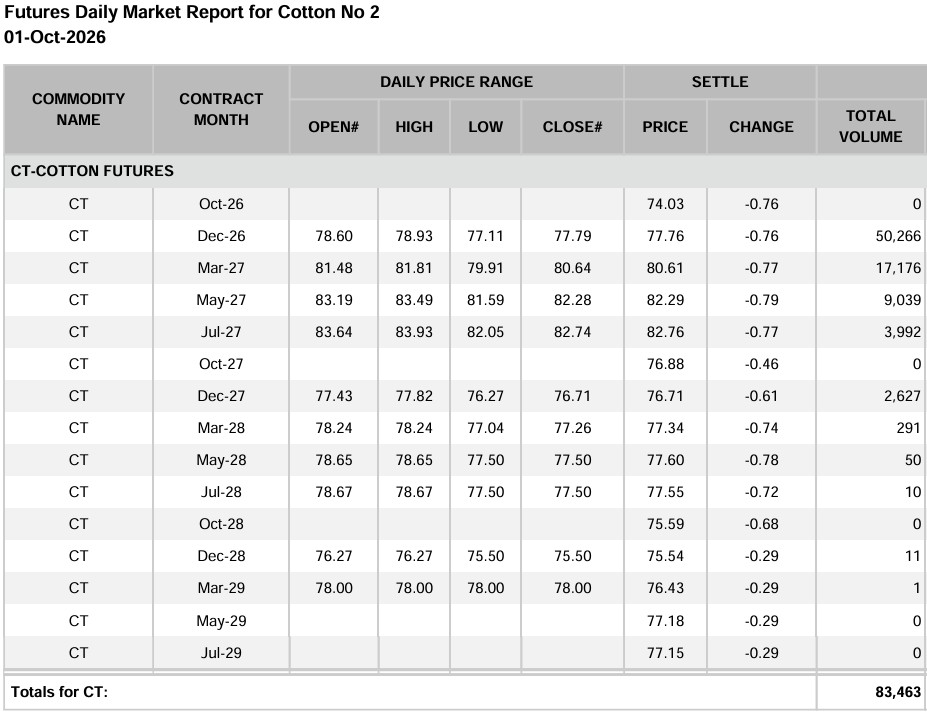
Barchart: Cotton futures lost 29 to 79 points on Thursday, with Dec26 at 77.76 cents (-76 points), Mar27 at 80.61 (-77) and Oct26 at 74.03 (-76). Crude oil gained about 2.7% on the session and the dollar index jumped sharply. The Cotlook A Index fell 390 points to 89.45 on Wednesday, catching up with Tuesday's limit-down move. ICE certified stocks slipped 47 bales to 28,017, and the Adjusted World Price was cut 93 points to 65.16 cents/lb.
Source: Barchart
U.S. Cotton: Five Cents Lost in Three Sessions as December Dips Below Its 200-Day Average
Calcot (Cindy Walters): December settled at 77.76 cents, taking its three-session loss to 510 points, and every contract through July 2027 is now down just over 5 cents since Monday. Volume was 83,463 contracts, almost identical to Wednesday. Open interest fell 2,855 contracts to 386,639 — the largest one-day drop since mid-July — and more liquidation was likely during Thursday's session. The weekly export report was surprisingly decent, with combined net sales for all crop years of 239,662 bales, and total 2026/27 commitments now stand at 5.13 million bales against 1.42 million shipped. Cotton and soybeans were among the few lower markets on the day, while the U.S. 10-year Treasury yield touched 5.342%, its highest since 2002, as investors weigh the prospect of rates staying higher for longer. Technically, December traded down to 77.11, slipping below its 200-day moving average for the first time since early March, and now has roughly three months of trading overhead as resistance. The latest on-call report showed unfixed mill sales exceeding unfixed producer purchases for the eighth consecutive week, at 83,295 contracts against 62,361. New certifications of 2,149 bales may be the first from the 2026 crop as harvest gets underway. The next USDA supply and demand report is due on October 9.
Source: Calcot
Global: ICAC Sees Consumption Overtaking Production in 2026/27
ICAC (Cotton This Month, October): World cotton production is projected at about 25.94 million tonnes in 2026/27, down 3.8% from 26.98 million, mainly because of reduced area across most major producing countries, while consumption is expected to rise about 1.1% to 26.14 million tonnes. That reverses the balance: a surplus of roughly 1.13 million tonnes in 2025/26 becomes a deficit of about 201,000 tonnes. Exports are seen easing 1.7% to 9.70 million tonnes and ending stocks slipping 1.1% to 17.50 million tonnes. The Secretariat forecasts the 2026/27 Cotlook A Index in a range of 65 to 99 cents per pound, with a midpoint of 80 cents. The issue also profiles West Africa, where average annual output has grown from about 27,000 tonnes in the 1940s to more than 1 million tonnes in the 2020s, largely through area rather than yield; production there is projected up about 6% to 960,000 tonnes in 2026/27, nearly all for export. Côte d'Ivoire is held up as the example of what is possible, with yields rising from about 259 kg/ha in 2022/23 to 483 kg/ha in 2025/26 on better pest management and input access. India increased its imports from several West African origins in 2025/26, and wider zero-tariff access to China could open further outlets.
Source: ICAC
U.S. Cotton: Shurley Says the Break Is Technical and Advises Growers to Wait
Cotton Grower (Don Shurley): Support around 82 cents failed to hold and December now stands just above 78 cents after a brutal week. Shurley hesitates to name the next floor but puts it at 76 to 78 cents, arguing that just as 93 cents was too high, anything below 78 may be too low — both extremes driven by market technicals rather than supply and demand. His advice to growers is to wait it out and hope for a recovery back above 82. Drought is expected to persist but improve, or be removed, across much of the cotton area over the next month; the damage is largely done, though better conditions can still help late development. As of September 27, 35% of the U.S. crop was rated poor or very poor, with Texas at 52%. Export shipments have been consistent and the latest weekly sales were much improved, but shipments need to average roughly 240,000 bales a week to meet USDA's 12.3-million-bale projection. World demand is projected at 122.92 million bales, 1.79 million more than last year and the highest since 2020.
Source: Cotton Grower
U.S. Cotton: Weekly Export Sales Hold Above 200,000 Bales, With China Among the Buyers
USDA: Net sales of upland cotton for 2026/27 totalled 202,600 running bales in the week of September 18-24, down 12% from the previous week but up noticeably from the prior four-week average — a good result. The main buyers were Vietnam (51,200 RB), Pakistan (40,600), China (38,400), Honduras (22,700) and Malaysia (12,100). Sales for 2027/28 came to 39,200 RB, mostly to Malaysia (30,800). Shipments of 149,500 RB were down 9% from the previous week and 11% from the four-week average, headed mainly to Vietnam (49,800 RB), India (25,300), Pakistan (15,800), Mexico (15,200) and Bangladesh (10,900). Pima recorded net cancellations of 2,100 RB, a marketing-year low, with shipments of 9,300 RB, mostly to India.
Source: USDA
Brazil: StoneX and Cotlook Launch a Brazil Basis Swap
StoneX: StoneX and Cotlook have launched the Cotlook Brazil Basis Swap, an over-the-counter cotton derivative available from October 1 that settles against the Brazilian component of the Cotlook A Index. The rationale is that Brazil overtook the United States as the world's largest cotton exporter in 2023/24 and now carries real weight in global pricing, yet the trade has lacked a tool for hedging the basis risk on Brazilian cotton across international supply chains. StoneX Markets holds an exclusive licence from Cotlook to develop and offer the product, which is aimed at farming cooperatives, merchants, mills and manufacturers. Cotlook presents the tie-up as an extension of its long-standing work on price transparency, while StoneX says its cotton customers have long asked for a way to manage this risk.
Source: StoneX
Australia: Planting Begins With the Crop Seen 40% Smaller on Water Shortages
Grain Central: Australia's 2026/27 cotton crop is forecast at about 2.7 million bales, down 40% from 4.5 million in 2025/26, from roughly 265,000 irrigated hectares and with an estimated value of A$2.1 billion. Planting began in Queensland's Central Highlands in early August, with St George and the Brisbane Valley following in recent weeks and most other regions starting next week. Water is the constraint: after a dry winter and limited storage inflows, most valleys have reduced allocations, notably the Macintyre, the Darling Downs, the Gwydir, the Macquarie and the southern valleys, and dryland cotton will be minimal unless significant rain arrives. Cotton Australia chief executive Adam Kay says access to water is the biggest driver of planting decisions this season, and the Bureau of Meteorology is forecasting a drier season ahead. In Western Australia, the Ord region expects 75,000 to 90,000 bales with good yields and fibre quality.
Source: Grain Central
Global: ICAC Review Looks at Brazil's Logistics Bottleneck and a Market Pulled Two Ways
TEXtalks: The September edition of ICAC's Cotton: Review of the World Situation opens with two market pieces. Jonathan Valério of Magna Logistics Solutions argues that Brazil's competitiveness is now decided after the gin: the country exported 3.027 million tonnes in 2025 and is expected to reach a record 3.418 million in 2026, yet about 95% of that moves through the Port of Santos, needing 110,000 to 120,000 containers a year and leaving exporters exposed to competition for trucks, port space and containers and to vessel delays. He points to greater use of the Port of Salvador for Bahia cotton — its container capacity is set to double — along with earlier logistics planning and contract terms that allocate rebooking and detention costs more clearly. In the second piece, StoneX broker Valentin Olah describes a market facing conflicting signals: a tightening balance sheet, with USDA putting production 5.6 million bales below consumption, alongside physical cotton readily available from several origins. December 2026 futures climbed from a contract low near 66 cents to almost 93 cents before giving back about nine. Higher oil and synthetic feedstock costs may support cotton relative to polyester, but dearer textiles also restrain demand, and Brazil's rise has made cotton available year-round, eroding the seasonal scarcity once associated with the U.S. crop.
Source: TEXtalks
The article summaries were generated using ΑΙ.