
EUR/US$: 1.1188
U.S. Cotton: Sharp Losses to Start the Week
Barchart: Cotton futures posted sharp losses of 61 to 114 points across most contracts on Monday, as crude oil fell and the dollar strengthened. The Seam sold 549 bales on October 23 at an average of 74.89 cents/lb, the Cotlook A Index fell 80 points to 91.95 cents, and ICE certificated stocks rose another 3,143 bales to 27,865. The Adjusted World Price stood at 65.01 cents/lb. Dec 26 settled at 79.06 (−114), Mar 27 at 82.86 (−108) and May 27 at 84.52 (−109).
Source: Barchart
U.S. Cotton: December Breaks Below Three-Week Range as Certificated Stocks Grow
Calcot – Cindy Walters: December settled at 79.06, down 114 points, well below the 79.23–82.25 range of the previous 14 sessions, on the heaviest volume since October 9. ICE's daily trading limit will be 300 points from October 27. Rising certificated stocks have weighed on the market, up 12,747 bales last week to 27,865, some of them in an Allenberg-owned warehouse and others possibly for Allenberg in independent Texas warehouses. December remained weak relative to the rest of the board, with the Dec/March spread setting new contract highs for a third session at 380 points March premium, ahead of index fund rolls beginning on Thursday. December now stands closest to its 200-day moving average at 78.25 cents, below which it has not closed in seven months. Soybeans led grains lower after Lula's surprise re-election in Brazil sent the real sharply lower, making Brazilian exports more competitive, while the Fed meets this week with rates expected to stay unchanged.
Source: Calcot
India: Duty-Free Cotton Imports Expected to Be Extended Through December
Reuters – Manoj Kumar, Rajendra Jadhav: India is expected to extend its waiver of the 11% duty on cotton imports, in place from June 1 to October 31, by two months through December, according to government and industry sources, a move that could cut costs for mills, curb domestic prices and boost imports from the U.S., Brazil and Australia. Domestic prices have stayed above 9,000 rupees per 100 kg, above the new season's floor price of 8,717 rupees, as poor rains, pests and outdated GM seed technology cut output. Production is likely to fall below 29 million bales in 2026/27 against demand of more than 34 million, and the stocks-to-use ratio is at about 31%, a five-year low. India's cotton imports rose 63% to $1.1 billion in April–September, though a trader warned that U.S. futures above 83 cents, high freight costs and a weaker rupee could limit large purchases.
Source: Reuters
Greece: Cotton Decouples from Grains on Texas Concerns
Agronews – Giannis Papadogiannis: Cotton moved apart from other commodities last week, gaining while grains posted heavy losses, with rising abandonment estimates in Texas the main driver. Mills worldwide have been active, confirming that prices around 80 cents are attractive for buying and price fixing. This activity has also reached the Greek crop, although large volumes of cheaper Brazilian cotton mean that only mills loyal to Greek cotton are buying, paying about 3 cents/lb above the corresponding futures month depending on shipment. Sales so far total about 80,000 tonnes, out of an estimated lint production of about 220,000 tonnes.
Source: Agronews
Global: Cotton More Encouraging Than the Wider Economy
Mambo – Armand Ezerzer: ICE December futures have held steady at 80–82 cents/lb, while open interest has risen sharply and speculative positioning leans bullish. El Niño is affecting the market through lower Brazilian crop quality, drought in the U.S. and the Indian monsoon, while low and often negative U.S. farm returns may discourage future planting. India's crop is estimated at 30.5 million bales, though Ezerzer doubts it will be reached, and Chinese physical demand remains firm as the market awaits purchases to rebuild reserves. On the macro side, U.S. inflation of 3.7% leaves the Fed unable to cut rates, the Iran conflict is disrupting shipping through Hormuz and Bab al-Mandab, and a EUR/USD target of 1.10 looks achievable. Overall, cotton appears more encouraging than the broader economy despite its sluggishness.
Source: Mambo
U.S. Cotton: Weekly Crop Progress
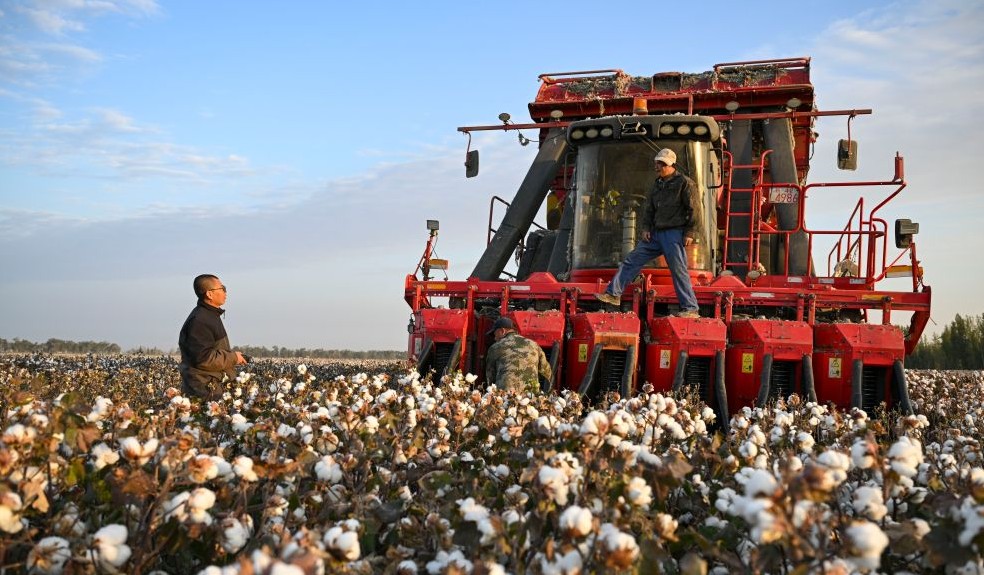
USDA: Bolls opening reached 89% of the U.S. crop, up from 85% the previous week but behind the 92% five-year average. Harvest advanced to 52%, from 41% a week earlier and ahead of the 45% average. Condition was rated 33% good-to-excellent, down 2 points on the week, while 37% was rated poor-to-very poor. Year-ago comparisons are not available because of the 2025 government shutdown.
Source: USDA NASS
China: Cotton Yarn Imports Hit 2026 High in September
Mysteel: China imported about 212,600 tonnes of cotton yarn in September, up 18% month on month and 66.4% year on year, the highest monthly total of 2026. Imports for January–September reached 1.6 million tonnes, up 54.8%. Vietnam supplied 103,600 tonnes, almost half of the total, followed by India (32,200 tonnes), Pakistan (23,100 tonnes) and Uzbekistan (16,600 tonnes). The average import price rose about 12% to $2,502/tonne, narrowing the gap with domestic yarn, while domestic C32S yarn prices fell from 24,251 to 23,851 yuan/tonne as the traditional "Golden September" peak season disappointed. Import growth is expected to slow, and domestic yarn prices may stay weak.
Source: Mysteel
U.S. Cotton: BCI Event Spotlights Regenerative Agriculture in the Texas High Plains
Cotton Grower: Better Cotton (BCI) and Quarterway Cotton Growers co-hosted "Cotton & Beyond: Regenerative Agriculture in the Texas High Plains" in Lubbock and Plainview, bringing together more than 50 growers, merchants, brands and researchers. Participants visited cotton fields, a gin, research labs and conservation sites. Growers stressed that practices must fit local conditions, as this season's drought showed large yield gaps between irrigated and dryland fields. At the Quarterway gin, attendees learned about bale traceability through the Permanent Bale Identification system and the uses of cottonseed and gin byproducts, while a playa restoration site showed how these wetlands help recharge the Ogallala Aquifer. The event returns in September 2027.
Source: Cotton Grower
Pakistan: Textile Exporters Warn EU–India Trade Deal Could Erode Their Advantage
Arab News – Ismail Dilawar: Pakistani textile exporters warn that the EU–India free trade agreement, expected to take effect in early 2027, could erode the tariff advantage Pakistan enjoys in Europe under the GSP+ scheme. Abdul Hadi, president of the SITE Association of Industry, said textile and apparel exports rose 5.26% to $5.03 billion in the first quarter of FY27, but rising production costs and regional competition threaten that growth. The sector, worth about $18 billion a year and some 60% of export earnings, remains reliant on low-value yarn, fabric and home textiles, and declining domestic cotton output has increased dependence on imported fiber.
Source: Arab News
Myanmar: Push to Expand Cotton Area and Yields
Global New Light of Myanmar: Myanmar's cotton area, which exceeded 800,000 acres in 2011-12, fell to about 330,000 acres in 2021-22 before recovering to over 540,000 acres in 2025-26, with the average yield rising from 436 to 499.2 viss per acre. Production now exceeds domestic demand, and reaching the target of 700 viss per acre could generate about $500 million in additional export revenue, with world prices at $1,800–1,900 per tonne. The country still imports much of its yarn and fabric, and the article urges high-yielding long-staple varieties, timely supply of quality seed, Good Agricultural Practices and integrated pest management, shifting the focus from quantity to quality.
Source: Global New Light of Myanmar
The article summaries were generated using ΑΙ.