
EUR/US$: 1.1216
U.S. Cotton: Futures Slip Lower on Monday
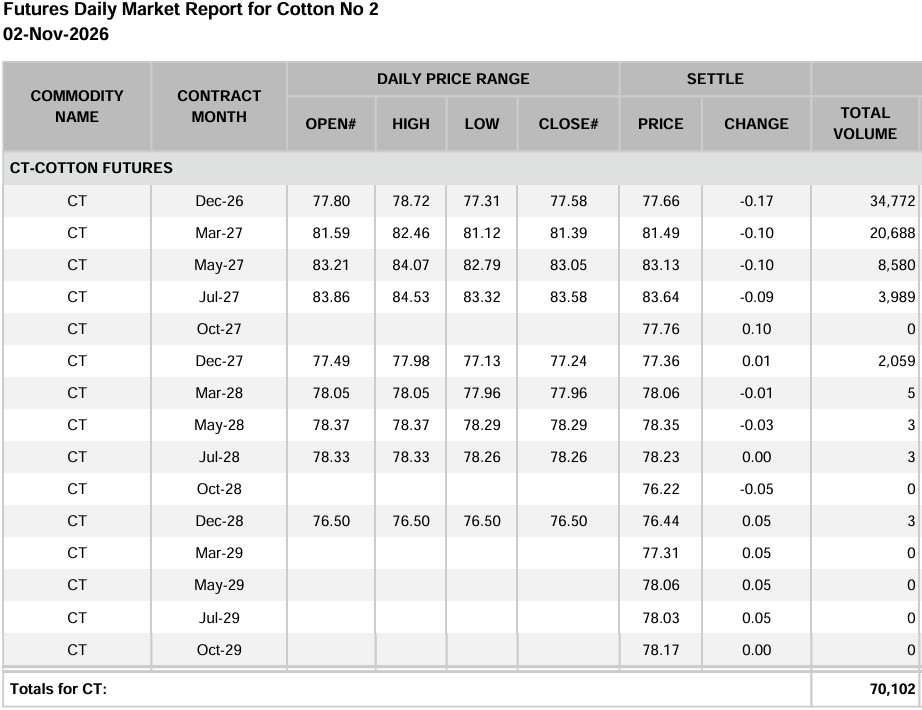
Barchart: Cotton futures recovered toward unchanged late in Monday's session but still closed 10 to 17 points lower, as crude oil plunged by around 8% and the dollar eased slightly. The Seam sold just 219 bales on October 30 at an average of 68.67 cents/lb. Dec 26 settled at 77.66 (−17), Mar 27 at 81.49 (−10) and May 27 at 83.13 (−10).
Source: Barchart
Global: Cotton Consumption to Exceed Production on Resilient Asian Demand
ICAC: In the November edition of Cotton This Month, ICAC projects 2026/27 world cotton production at 25.75 million tonnes, down about 4% from 26.85 million, and consumption up 0.8% to 26.10 million tonnes, so consumption would exceed production by about 353,000 tonnes after last season's surplus of nearly 961,000 tonnes. Output is expected to fall in China (to 7.2 million tonnes), Brazil (to 4.10 million), Pakistan (−17%) and the US (−4%), while India stays at 5.3 million and West Africa rises to about 954,000 tonnes. Demand is supported by Asian textile industries: China at 8.53 million tonnes, India at 5.9 million, Pakistan up 5% to 2.1 million after five years of decline, Vietnam at about 1.77 million and Türkiye up from 1.4 to 1.5 million tonnes. World exports are forecast to fall 1.7% to 9.75 million tonnes, led by Brazil (3.15 million), the US (2.71 million) and Australia (1.02 million). ICAC forecasts the 2026/27 Cotlook A Index between 73 and 106 cents/lb, with a midpoint of 87 cents.
Source: ICAC
Global: Brazilian Wave Builds as Market Waits for Demand
Mambo: December futures fell 1.46% over the week to November 2 and the Cotlook A Index 1.90% to 90.20 cents, against a backdrop of strong uncertainty: the US midterm elections, rising government bond yields, a strong dollar, a Fed holding rates and unresolved geopolitical crises. A 13% fall in the Brazilian real is driving a wave of Brazilian exports, with basis levels still declining and leaving other origins struggling to compete. US weekly export sales remain good, but shipments are disappointing. India's two-month suspension of the reimposition of import duties brought relief to traders, while the rebuilding of Chinese state reserves, widely expected, has yet to begin. The market needs sustained demand to hold up, but that demand is slow to appear given the uncertain economic outlook.
Source: Mambo
Greece: Market Waits for December '26 Contract to Expire
Agronews: December '26 futures have broken support at 80 cents and the spread to March '27 has widened, meaning the market values later-delivery cotton more highly than nearby cotton. Rising US export sales show mills want to take advantage of current prices, while heavy speculative long positions in December are causing turbulence as the time to roll them approaches. In Greece, the whole market is waiting for December to expire so that talks can restart on the basis of March '27 prices, as analysts say the spread is too large to be offset by the nearby shipment and payment terms of December-based contracts. Turkey is showing some interest at fixed prices, but because these are based on the low December contract, the final price does not satisfy gins.
Source: Agronews
U.S. Cotton: The Week Ahead
PCCA – Cotton QuickTake: Cotton enters November under pressure after December lost 237 points last week to 77.83 cents, hit by the sharp fall in the Brazilian real after President Lula's re-election, which encouraged more selling from Brazil, and by Friday's technology sell-off. December closed below its 200-day moving average and is struggling to find support, although some buying interest is emerging at lower prices, while the upcoming roll into March could add activity. The midterm elections and employment data may influence the dollar and expectations for the Fed's December decision, while possible US-China talks later this month are worth watching for cotton. Attention is also turning to the November 10 WASDE, after USDA raised US production last month. India's extension of duty-free imports to December 31 is positive, though shipping times may limit additional business, and recent rains have slowed harvest in parts of West Texas.
Source: PCCA
U.S. Cotton: Harvest Well Ahead of Average
USDA: The US cotton harvest reached 63%, up from 52% a week earlier and well ahead of the five-year average of 54%. Bolls open reached 92%, slightly behind the 95% average.
Source: USDA NASS
U.S.: What Seed Tests Can and Cannot Tell Cotton Growers
Farm Progress – Cotton Incorporated: Germination tests show whether seed is viable, but field emergence also depends on soil moisture, temperature, planting depth, pests and crusting, so germination and stand establishment are not the same. A Beltwide survey of 415 samples started in 2020 found that 91% of commercial seed lots had good warm germination, but cool germination results varied between laboratories and were a poor predictor of stand establishment. Researchers at North Carolina State University are developing more consistent tests and image-based assessment of mechanical damage, while others in Texas and Arizona track quality through production, harvesting and ginning. As breeding has raised lint yields, seed size has declined, making seed less forgiving of deep planting and poor soil conditions, so growers are advised to obtain quality analyses for purchased seed and match planting depth and timing to each lot and to field conditions.
Source: Farm Progress
The article summaries were generated using ΑΙ.