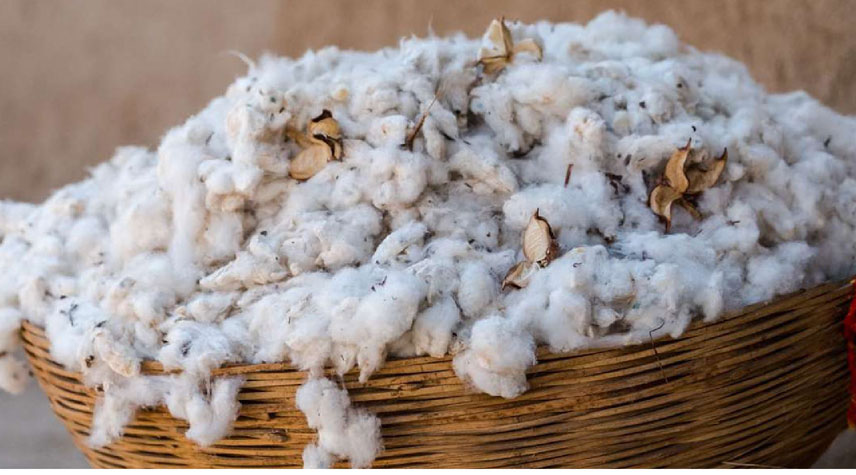
Cotton Futures, July 27
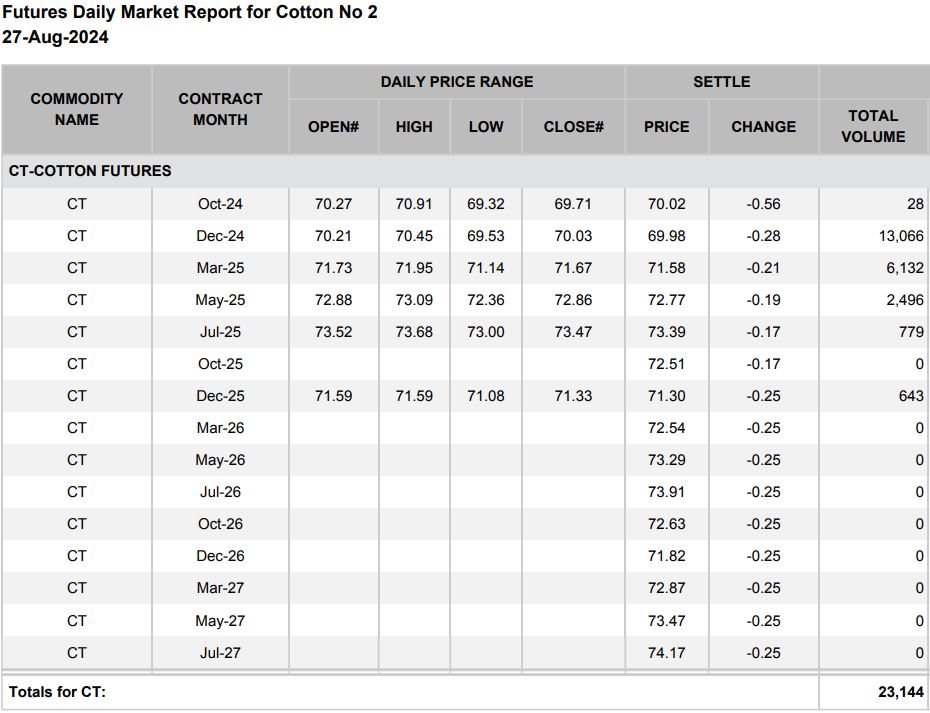 EUR/US$ 1.1389
Barchart: Cotton Closes Monday with Gains
Barchart: Cotton futures gained 54 to 90 points on Monday as crude oil fell sharply, down $7.40 a barrel. USDA's Crop Progress report showed 81% of the U.S. crop squaring and 45% setting bolls, both close to seasonal norms, while overall condition improved slightly to 46% good/excellent. The Cotlook A Index held steady at 90.35 cents, and the Adjusted World Price was trimmed to 63.82 cents/lb.
Source: Barchart.com
PCCA: Cotton QuickTake
PCCA: The market enters the week focused on Wednesday's Federal Reserve meeting, alongside weather, export demand, and Washington developments that could affect farm policy. December settled the week at 79.98 cents, up 135 points, supported by weather concerns and firmer outside markets. The share of the crop in drought eased from 46% to 42%, though conditions remain uneven, with fresh heat expected in West Texas. Managed money continued adding to net long positions for another week. Export sales reached 51,300 bales (China the top buyer) while shipments hit 276,300 bales; the U.S. will need to average roughly 355,000 bales a week for the rest of the season to reach USDA's 12.2-million-bale export target — an increasingly difficult goal.
Source: PCCA.com
USA Cotton: Crop Progress
USDA: Weekly report on U.S. cotton crop progress: 81% of the crop is squaring, up from 73% the prior week, 79% a year ago, and matching the five-year average (81%). 45% has set bolls, up from 32% the prior week, versus 42% a year ago and in line with the five-year average. 46% of the crop is rated good/excellent, a slight improvement from 45% the prior week, but below the 55% recorded a year ago.
Source: USDA - NASS
MAMBO: Our Vision of the Cotton Market 27/07/2026
MAMBO: Cotton is showing stability for now, trading around 80 cents/lb for the December 2026 contract on ICE New York, though the physical market is seeing an erosion of fundamentals. China is importing large volumes as the season nears its end, while India remains cautious despite the suspension of import duties, which hasn't delivered the expected boost. Bangladesh and Vietnam, major importers, are also holding back, which is attributed to fears of a slowdown in the textile sector amid broader economic uncertainty. Concerns over rising production costs — driven by climate uncertainty, fuel prices (Russia has restricted diesel exports), and input costs — are being confirmed daily, making a price decline hard to imagine under these conditions.
Source: Manbo.com
Bangladesh Targets 1.9 Million Cotton Bales by 2050 to Cut Import Dependence
Bangladesh: The country's Cotton Development Board (CDB) has set a target to raise domestic cotton production to 1.9 million bales by 2050, up from roughly 224,000 bales today (16-17% of domestic demand), with an interim goal of 500,000 bales by 2030. The country's textile industry consumes around 9 million bales a year, with imports covering 7.5-8 million bales (7.3 million bales were imported in FY2025-26). Cotton cultivation currently covers about 45,000 hectares, with the CDB estimating potential to expand to 200,000 hectares. To support the expansion, the government provided cultivation incentives in FY2026-27, with roughly 25,000 smallholder farmers across 26 districts receiving seeds, fertilizer, and pesticides.
Source: TextileToday.com.bd
80-82 Cents Serve as a Barometer for the Cotton Market
Agronews (Γιάννης Παπαδογιάννης): The New York market pulled back toward 78 cents before recovering on speculative buying, reinforcing 80 cents as a key technical level — spinning mills tend to fix prices there, while producers tend to lock in prices around 82 cents. In Greece, sales of this season's remaining stock are moving slowly over summer, with buyers cautious on new-crop unless offered a competitive basis, and ginners holding out for a basis above 4 cents/lb.
Source: Agronews.gr