Raney Rapp, Senior Staff Writer, Delta Farm Press
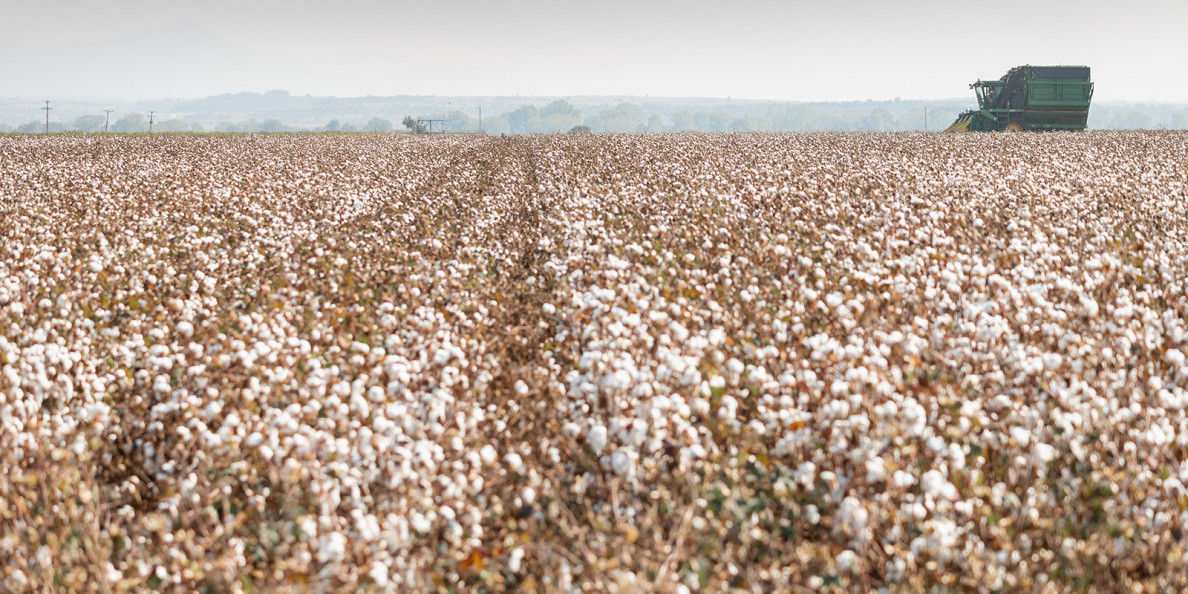
Cotton is king. Or at least it was in Arkansas in 1930, when 10% of the state’s available land mass, more than 3.5 million acres, was loaded with fluffy white bolls. The once-king cash crop has come a long way — and left prices behind.
Cotton breeders, such as Fred Bourland at the University of Arkansas, are facing down a nearly 10-year price leveling and pushing against genetic barriers to produce next-level yields.
“How long can cotton prices be stagnant? That’s really what they are,” Bourland said. “The way we’ve survived price is by increasing yields.”
In general, Bourland said cotton yield steadily increases in the U.S. by about 10 pounds per acre each year, outside of brief plateaus. While there’s much to be learned about cotton’s genetic progress, Bourland said he looks to the underlying issues in those stagnant yield years for clues to level up.
One notable plateau in the 1940s can be attributed to stalled production and research during World War II. Once farmers returned home and research funding began anew, change came quickly. In the 1960s, overuse or uneducated applications of new spray technology hindered yield and was quickly resolved with education and greater emphasis on integrated pest management. In the 1980s, weevil and worm resistance limited progress, and in the early to mid-2010s, weather challenges took their toll.
The question for cotton yield today is, “Have we gone as far as we can go?” Bourland asked.
“If you go out to Arizona or Australia, what’s the physiological limits? I’ve even heard up to nine bales per acre,” Bourland said. “With our genetics, you cannot make nine bales per acre here unless you make your acres three times as big as they are. Can we change how the genetics relate to the environment to expand the physiological limitation?”
If history can lend hints to areas of improvement for current cotton breeders, Bourland said he sees a few areas where experts could look to expand yield opportunities.
Cotton composition
One big change in cotton plant composition originally occurred when varieties started needing less time to mature. To make shorter seasons a reality, breeders selected differently.
“When we started going to short-season varieties, breeders started selecting for less monopodial branches to get earlier maturity, and I think our plants still have that tendency,” Bourland said.
To reduce seed costs once new variety technology led to increased seed prices, producers lowered plant population density. “What’s the role of monopodial branches now when we’ve got a lower plant density?” Bourland said. “We may start need to begin breeding those back into the system.”
One of the most exciting changes to cotton production — an increase in fiber length — also provides challenges for farmers hoping to truly maximize yield.
“How much change have we made in fiber link? About 0.1 inch,” Bourland said. “That 0.1 inch makes incredible differences in spinning, so that’s a major change. But when we increase fiber length, what happens to yield? It tends to go down.”
Fiber density
Increasing overall lint as well as fiber density is one of the most promising areas Bourland sees for yield advancement.
“A few years ago, I started playing with fiber density, and one thing I’m doing now is making two measurements of fiber density. One is determining the number of our estimated number of fibers per unit area of seed coat, and the other is estimating the mass or weight of fibers per unit area of seed coat.”
After several seasons marking those measurements, Bourland said he’s seen a big difference between varieties. “That tells me there’s some opportunities to make improvements, and perhaps we can get that plant making those things more efficiently.”
Because lint is often more efficient for the cotton plant to create than seeds, it could have big implications for future genetic yield progress.
“Cotton yield is the number of seed per acre times the amount of lint per seed,” Bourland said. “It’s a lot more efficient for that plant to produce lint per seed than it does seed per acre. It takes less plant energy.”
Fruiting positions
If you’re not increasing yield by having more lint per boll, then there must be more bolls per plant. Bourland estimated there must be about 140,000 bolls per acre to make one bale per acre yield. If typical plant populations are around 40,000 plants, then it takes around three and a half bolls per plant to yield one bale per acre.
“Prime fruiting sites are the first and second position on the main stalk. So, there’s 14 prime fruiting sites per plant,” Bourland said. “If we can set bolls on all of those, we just made four bales an acre.”
Prime fruiting sites only make up 80% of total yield, Bourland said. So, with all prime fruiting sites filled, producers could make up to five bales per acre. The potential is there.
“Are we going to set all our positions? No,” Bourland said. “How do we get more of those positions if we want in that range, four to five bales, while having some loss of fruit? We’ve got to expand the 20-day flowering window.”
Planting earlier would increase the flowering window, he said. But often, early planting just is not an option. “There’s some real issues there to be able to expand those 20-days,” Bourland said.
“The potential is there,” he said. “To realize that potential? It’s really challenging.”
Source: farmprogress.com