EUR/US$: 1.1555
Cotton Slip into Monday's Close
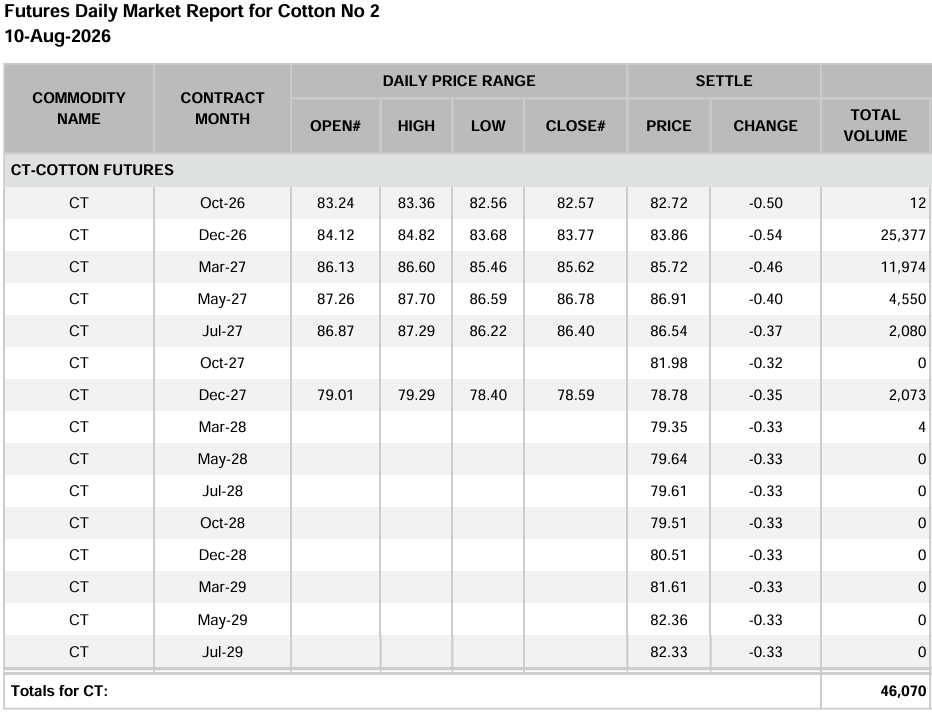
Barchart: Cotton futures slipped into Monday's close, with contracts down 46 to 55 points on the day. USDA's weekly Crop Progress data showed 65% of the U.S. cotton crop had set bolls as of Sunday, with 10% of bolls open, and condition ratings held at 40% good-to-excellent. The Seam reported 246 bales sold on August 7 at an average price of 81.82 cents. The Cotlook A Index rose 20 points to 93.70 cents, while ICE certified stocks were steady at 84,632 bales. The Adjusted World Price was raised 163 points to 66.29 cents per pound. October '26 cotton settled at 82.72 cents, down 50 points; December '26 closed at 83.86, down 54 points; and March '27 finished at 85.72, down 46 points.
Source: Barchart
Weather Risks Support Cotton, Demand Lags Behind
Agronews: Concerns over the size of this year's U.S. crop continue to underpin cotton prices, but limited demand and uncertainty in global trade are keeping the market from a stronger rally. Weather-related risks to the crop remain the main supportive factor, while buyers on the physical side are staying cautious.
Source: Agronews.gr
USDA Crop Progress: Cotton Update, Week Ending August 9
USDA: The USDA's weekly Crop Progress report, released Monday for the week ending August 9, showed the U.S. cotton crop 93% squared, matching the five-year average. Bolls setting reached 65%, slightly behind the 67% average pace, while 10% of bolls had opened, close to the 9% average. Overall crop condition held at 40% good-to-excellent, unchanged from the previous week but down from 53% a year earlier.
Source: USDA NASS
Small but Mighty: How Australian Cotton Continues to 'Kick Goals'
Nutrien: Although Australia produces only a small share of the world's cotton, growers there say the country sells every bale it produces, thanks to a reputation for quality. The Australian Cotton Shippers Association reported average yields of 12-14 bales per hectare this year, with strong fibre length and strength across regions. A Nutrien market insights lead said tighter global supply and rising prices for synthetic fibres are supporting demand for cotton, while the industry's sustainability credentials, including bale-level traceability, continue to appeal to buyers.
Source: Nutrien
High Plains Farmers Pivot to Long Staple Production
Cotton Grower: A group of Texas High Plains producers has spent recent seasons shifting part of their acreage to long-staple cotton in search of better returns. After trialling a DynaGro variety with fibre closer to Pima quality, growers Carroll and Rodney Leon scaled up to over 2,000 acres, prompting the local Petersburg Co-op Gin to build a new roller gin dedicated to the crop. The extra cost of growing long-staple cotton, roughly 15-20 cents more per pound, has so far been offset by premiums of around $1 per pound, compared with about 65 cents for standard upland cotton this year.
Source: Cotton Grower
Synthetic Fabrics Kneecapped American Cotton. Industry Leaders Have a Plan to Revive It
KCUR: U.S. cotton industry leaders are backing new legislation, the Buying American Cotton Act, that would offer tax credits to manufacturers using U.S.-grown cotton, aiming to reverse two decades of stagnant demand as synthetic fibres have taken market share. The National Cotton Council estimates the incentives could support up to four million additional bales of production a year. The push is paired with the USDA's "Great American Cotton Plan" and the industry's "Plant Not Plastic" campaign, which highlights microplastic pollution from synthetic textiles to promote cotton as a natural alternative.
Source: KCUR / Harvest Public Media
Australian Cotton Top Pick for Indian Mills
Grain Central: Speaking at the Australian Cotton Conference, Gill & Co co-owner Mohit Shah said Indian mills increasingly favour Australian cotton for its consistency and freedom from contamination. Australia became India's second-largest cotton supplier in 2025-26, after the removal of India's import duty and competitive pricing versus U.S. and Brazilian cotton pushed imports to a five-year high of more than 200,000 tonnes. Shah said India's growing textile consumption, combined with limited gains in domestic yields, should keep import demand strong, though rainfall over the coming weeks will be key to the size of this season's Indian crop.
Source: Grain Central
Stakeholders Warn of Increasing Dependence on Imported Cotton
ΠΑΚΙΣΤΑΝ: Even as Pakistan's textile exports hit a record $1.83 billion in July, industry figures are warning that heavy rains and the continued expansion of sugarcane at cotton's expense are increasing the country's reliance on imports. Contamination and moisture in this year's harvest have made it harder for mills to source quality lint domestically. Ginners called for tariff protection, contrasting Pakistan's policy with India's much larger state cotton-purchasing programme, while Pakistani mills, which need around 15 million bales a year against domestic output of only 5.5-6 million, are expected to import roughly seven million bales again this season.
Source: Dawn