EUR/US$: 1.1570
Cotton Posting Gains Heading into the Weekend
Barchart: Cotton futures rallied back on Friday, with most months up 0.96 to 1.33 cents. Crude oil rose 66 cents a barrel, and the dollar index eased $0.335. Export sales data put 2025/26 accumulated export business at 11.977 million bales, 107% of the USDA's projection, with accumulated shipments of 11.198 million bales rounding out the marketing year; new-crop business of 4.026 million bales is running 25% ahead of last year's pace. December cotton closed at 84.83 cents, up 1.33 cents on the day.
Source: Barchart
Calcot Market Comment – August 14, 2026
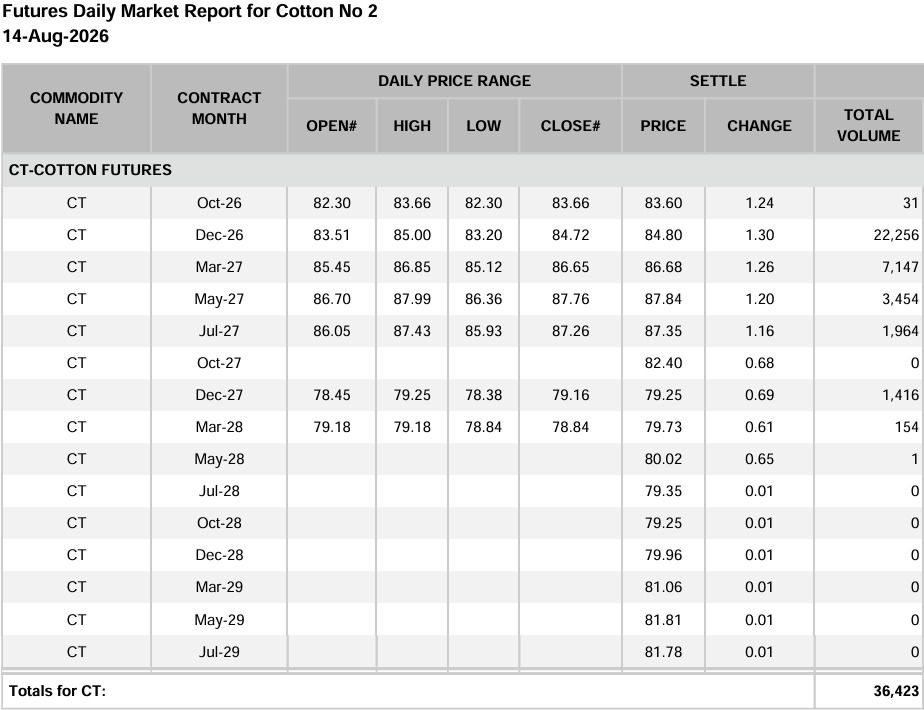
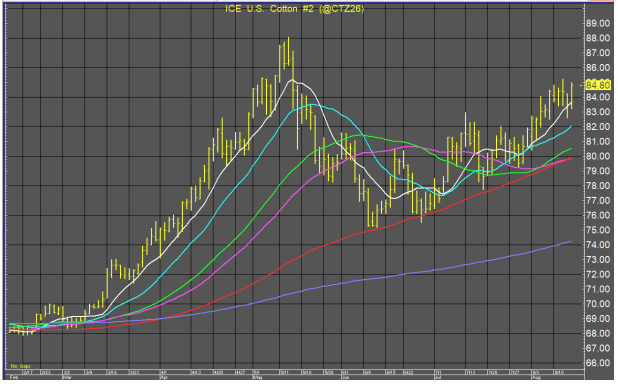
Calcot: Cotton futures closed the week with gains, with December settling at 84.80 cents, up 1.30 on the day and 0.40 for the week, the sixth weekly gain in the last seven, and its highest close since mid-May. Volume was 36,423 contracts, lighter than Thursday's 56,288. Friday's CFTC data (through Tuesday) showed speculators as net buyers for a sixth week out of the last seven, while the trade stayed on the sell side as growers kept pricing cotton into the rally; open interest reached 351,249 contracts, a more than four-month high, with a tenth straight daily increase. Outside markets sent mixed signals: crude oil posted its first weekly gain in three weeks on continued Strait of Hormuz uncertainty, grain markets rallied hard (wheat +4.7%, corn +4.6%, soybeans +1.4% for the week), and US equities were mixed. China's state reserve completed its 20th consecutive sold-out auction, moving about 8,010 tonnes and taking the 20-day cumulative total to roughly 705,400 bales, split about 48% US, 20% Brazilian and 32% Xinjiang cotton.
Source: Calcot
Cotton Market Summary as of Friday, August 14, 2026
TAMU (Dr. John Robinson): ICE cotton futures traded up and down within the low-to-mid 80s this week, with December settling Friday up 1.30 cents at 84.80 cents. Chinese cotton prices were mixed, as was the world A-Index. Other ag futures were mixed too: corn traded flat then edged higher, soybeans and wheat drifted sideways with a slight uptrend, WTI crude rose before weakening, and the dollar index trended higher before reversing lower. Squaring, boll-setting and boll-opening rates were close to the five-year average through August 9, while the overall crop condition slipped to 40% good-to-excellent with another 38% fair; Texas stayed mostly hot and dry, and northwestern Texas continues to see damage from dryness and heat. Current-marketing-year export sales reflected cancellations, while new-marketing-year sales were fair. CFTC data through August 11 showed hedge funds adding more longs than shorts and index funds extending their net long position. Falling ICE certified stock levels could reflect improving commercial demand, and unfixed call sales have risen past unfixed call purchases.
Source: The Cotton Marketing Planner (TAMU)
CAI Raises 2025-26 Cotton Pressing Estimate to 339 Lakh Bales
Investing.com (Kedia Advisory): The Cotton Association of India raised its 2025/26 pressing estimate by 200,000 bales to 33.9 million bales (170 kg each), on higher numbers from Maharashtra, Madhya Pradesh, Karnataka and Tamil Nadu, partly offset by a cut in Upper Rajasthan. CAI also raised its import estimate by 200,000 bales to 6.2 million for the season, up sharply from 4.1 million last year, with about 5.4 million bales already landed by July 31. Total supply is now estimated at 45.66 million bales (5.56 million opening stocks, 33.9 million pressing, 6.2 million imports), against domestic consumption held at 34.8 million bales. Exports are projected at 1.5 million bales, down from 1.8 million last year. The combination leaves closing stocks projected at 9.36 million bales, up 3.8 million bales year-on-year, an inventory build that analysts say could keep domestic cotton prices under pressure unless demand improves.
Source: Investing.com
Natural Fibres Push a Boost for Cotton
Daily Cargo News (David Sexton): Speaking after the Australian Cotton Conference on the Gold Coast, which drew more than 3,000 delegates, Australian Cotton Shippers' Association chief executive Jules Willis said rising demand for natural fibres over synthetics is good news for the international cotton trade. With oil prices pushing up the cost of synthetic fibres, she said cotton's biggest competitor isn't Brazil or the US but synthetics, and cotton currently offers good relative value; roughly 30 years ago cotton and other natural fibres accounted for about 80% of the textile market, a share the industry now wants to claw back. She described current conditions as a chance to "strike while the iron is hot" and grow cotton's market share. On the supply side, delegates also discussed a changing climate and El Niño, which could mean drier conditions and a smaller Australian crop after a couple of strong production years; Willis said water allocation to agriculture will be the key swing factor, and that the outlook "can change rapidly" if rain arrives. Australia typically exports 4.5 to 6 million bales of cotton a year, depending heavily on seasonal water availability.
Source: Daily Cargo News