

EUR/US$: 1.1583
Cotton Sees Profit Taking Pressure to Close the Week
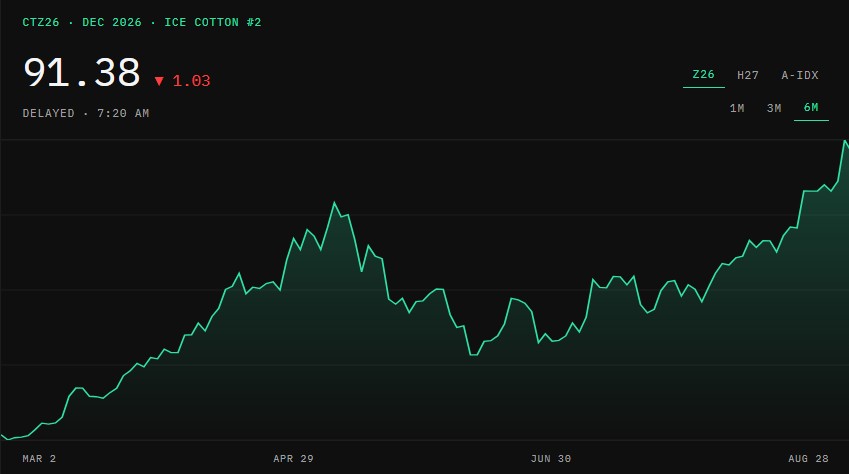
Barchart: Cotton futures gave back some ground on Friday, with front-month contracts down 0.19 to 1.14 cents in profit-taking, though December still closed the week up 3.03 cents. The 2026/27 export sales commitment now stands at 4.332 million running bales, up 27% from a year ago and 38% of USDA's full-season export target - ahead of last year's pace at this point but still trailing the five-year average.
Source: Barchart
Cotton Market Summary: Crop Conditions Steady, Supply Risks Build
TAMU (Cotton Marketing Planner): This week's outlook highlighted crop conditions holding near five-year norms for boll setting and opening through August 23, even as the overall crop slipped to 37% good-to-excellent (34% fair) amid persistent Texas drought and heat. Falling ICE certified stocks point to improving commercial demand, and the report flags several supply-side risks to watch - reduced Australian acreage, South Asian monsoon disruptions, and flood risk in Xinjiang - that could tighten global supply and support firmer prices going forward.
Source: TAMU Cotton Marketing
USDA GAIN: India Cotton Production Forecast Trimmed on Monsoon Risk
USDA GAIN (India, Aug 27): FAS Mumbai trimmed its MY2026/27 India cotton production forecast 3% to 24.5 million bales, with yields seen down 2% at 464 kg/hectare as below-normal rainfall is expected through August-September, with western and central India most at risk of dry spells; the cumulative monsoon deficit has narrowed to 12% below normal as of August 12, and planting is running about 2% behind last year. Post raised its mill-use forecast to 26.2 million bales on strong textile and apparel export demand, helped by new trade deals with the UK, UAE and Australia. Higher minimum support prices (long-staple MSP up 7% to $90.83 per 100 kg from October 1) and tighter crop prospects are keeping lint prices firm, pushing mills toward imports - aided by an 11% import duty exemption running through October 31 - while raw cotton available for export stays limited as more fiber is directed to domestic mills; the export forecast holds at 1.2 million bales, with Bangladesh absorbing 88% of shipments.
Source: USDA FAS (GAIN)
USDA GAIN: Mexico Cotton Production Recovers on Higher Prices
USDA GAIN (Mexico, Aug 27): Post forecasts Mexico's MY2026/27 cotton production at 0.87 million bales, up 32% - still historically low, but recovering as growers in Chihuahua (87% of forecast area) return to cotton after fiber prices rose about 40% since February's lows, lifting planted area 37% to roughly 97,000 hectares. Domestic consumption stays flat at 1.3 million bales, well below pre-pandemic levels of 1.8-1.9 million, as core inflation squeezes apparel spending and mills - running at just 60-70% of capacity - keep losing ground to Asian imports. Imports are seen easing slightly to 0.60 million bales, with the US retaining its dominant share under USMCA, while exports are forecast to rise 9% to 0.12 million bales on the larger crop. NY cotton was quoted at 86.96 cents/lb on August 20, up 23% year-on-year.
Source: USDA FAS (GAIN)
Rising Cotton Prices Give African Exporters New Window to Boost Revenues - Afreximbank
Ecofin Agency: Afreximbank's July report, "Cotton: A Global Recovery and Africa's Opportunity," says cotton futures climbed to around 80.5 cents/lb in July - up 35% from February lows - as global production is set to fall 5.5% to 116 million bales in 2026/27 while mill consumption rises to 122 million bales, pushing global stocks to their lowest since 2018/19. That recovery is a mixed blessing for African producers: Chad, Cameroon and Mali are expected to harvest only about 1.3 million bales this season, down from 1.9 million bales in 2021/22, held back by climate shocks and low productivity. Afreximbank argues the region's long-term competitiveness depends on raising yields, improving logistics and building local processing capacity, pointing to Benin's Glo-Djigbe industrial zone, where value-added manufacturing could turn $40 million of raw cotton exports into $800 million.
Source: Ecofin Agency
China's New Cotton Law Deepens Control Over Uyghur Farmers' Land and Labor
Global Voices: A new set of regulations in China's Xinjiang Uyghur Autonomous Region, the "Regulations on Promoting Cotton Quality," took effect July 1 and is officially framed as a quality and supply-chain traceability measure. It requires growers and cotton businesses to keep records - grower identity, land plot, variety, purchase dates, processing history - for at least five years, with every bale barcoded, and gives authorities inspection, credit-rating and licensing powers over the sector. The article situates the law within Xinjiang's post-2018 land reforms, which separated land ownership from day-to-day management in favor of cooperatives and state-approved entities, and notes that around 7 million people work in the region's cotton sector, about 70% of them Uyghur or other indigenous groups, even as mechanization has reached 97%. The author argues the traceability system operates within a broader framework of land, labor and political oversight rather than guaranteeing farmers' voluntary participation.
Source: Global Voices