EUR/US$: 1.1614
U.S. Cotton: Cotton Eases Lower into Labor Day Weekend
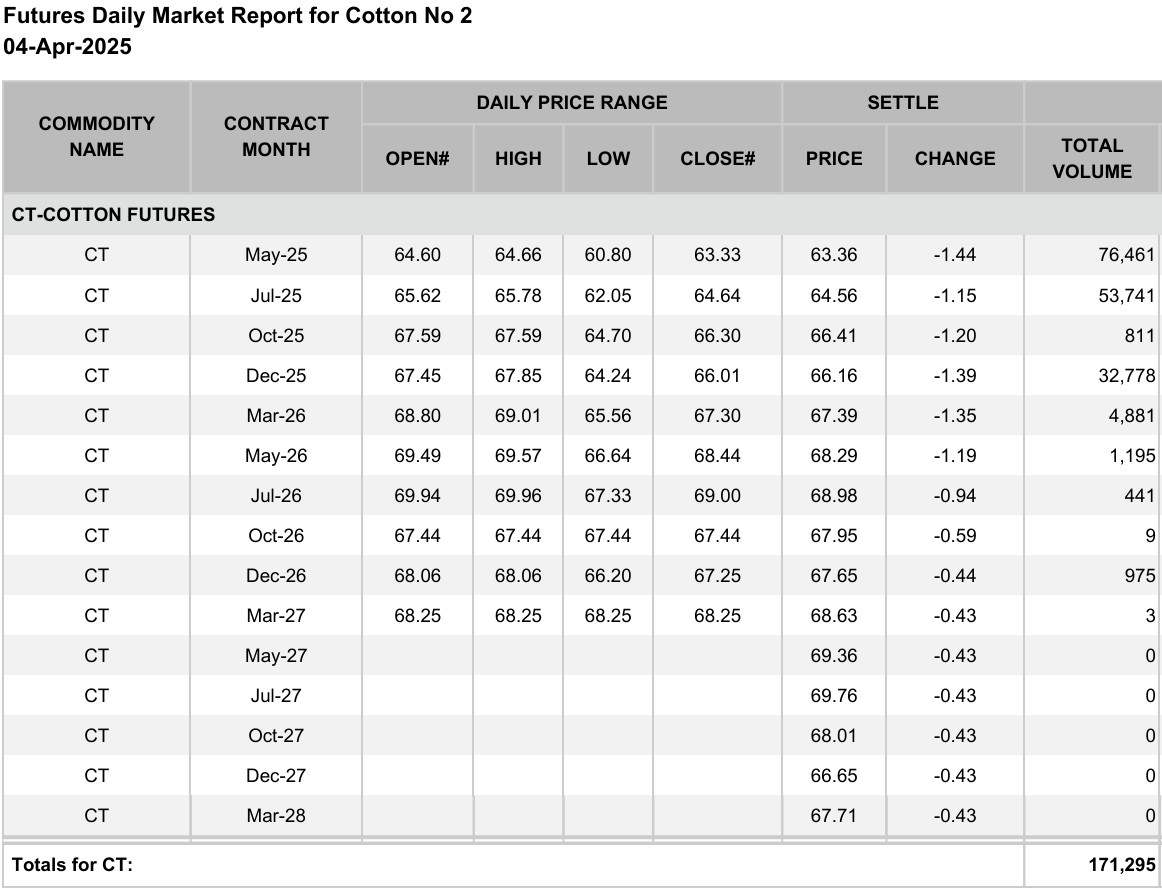
Barchart: Cotton futures eased into the long weekend, with front months down 12-94 points and deferreds up 2-68 points; December finished the week 505 points lower, its first weekly loss in seven weeks. CFTC data through Tuesday showed managed money closing in on a record net long, up 12,135 contracts to 107,976. Marketing-year export sales for 2026/27 upland cotton reached 4.36 million RB, up 19% y/y but still lagging the 5-year pace (38% of the USDA projection vs. a 45% average). The Cotlook A index eased to 98.25, ICE certified stocks held at 63,092 bales, and the Adjusted World Price rose to 73.92 cents/lb. The market is closed Monday for Labor Day.
Source: Barchart
U.S. Cotton: Calcot Daily Market Comment - Fourth Straight Loss, Record Volume Year
Calcot: Friday marked a fourth straight lower close for the front months, and December ended the week down 505 points - its first weekly loss in seven weeks - despite Monday's gains. Volume and open interest remain historically massive: 2026 has already topped every prior full year's total volume with four months still to go, and open interest has stayed above 300,000 contracts all year, a level topped in only two other years (2018, 2025). Friday's CFTC report (data through Tuesday) showed managed money still net buying for a fifth straight week, though Calcot notes specs were likely sellers later in the week. China's State Reserve logged its 35th consecutive sold-out auction (8,000 tonnes), with the running total near 1.24 million bales, roughly half US-origin. Crude oil surged 9.7% on the week on the US-Iran conflict, adding to inflation concerns ahead of next week's Fed meeting and CPI/PPI data.
Source: Calcot
U.S. Cotton: Texas A&M Weekly Market Summary
Texas A&M (Dr. John Robinson): U.S. crop condition held close to historical norms through August 30 at 39% good-to-excellent, though 29% was rated only fair. Northwest Texas remains the trouble spot, with heat and dryness stress reported despite scattered rain elsewhere in the Belt. Export sales stayed weak for the marketing year, though weekly shipments are tracking closer to the USDA's pace. Hedge funds added 5,583 net long contracts and cut shorts by 5,002, while index funds added another 3,774 net longs - a further build in an already bullish positioning picture.
Source: Texas A&M Cotton Marketing
China: USDA Lowers 2026/27 Production Forecast on Xinjiang Weather
USDA (GAIN): USDA trimmed its China 2026/27 cotton production forecast to 7.12 million tonnes (32.7 million bales), down 5.6% from the 2025/26 estimate, citing a policy-driven cut to Xinjiang's planted area plus less favorable weather than last season. Chinese industry estimates for 2026/27 range widely, from 6.34 to 7.26 million tonnes. USDA also revised its 2025/26 China import estimate up to 1.58 million tonnes (7.24 million bales), reflecting a widening price gap between costlier domestic cotton and cheaper imports. China's National Bureau of Statistics put actual 2025/26 production at 6.64 million tonnes, up 7.7% y/y, on 2.98 million hectares planted at a national average yield of 2.3 tonnes/ha; Xinjiang accounted for 92.8% of that output.
Source: USDA FAS (GAIN)
Pakistan: Cotton Arrivals Surge 27% as Weather Improves Yields
Dawn: Pakistan's cotton arrivals reached nearly 1.7 million bales by August 31, up 27% year-on-year, as dry weather, cooler nights and favorable winds lifted per-acre yields and reduced trash and moisture content. Sindh led with 1.14 million bales (+31%), with Sanghar district the top producer nationally; Punjab added 557,000 bales (+20%). Domestic mills bought 975,000 bales (+34% y/y) and exporters took another 70,600 bales, with 332 ginning factories now operating. The Cotton Ginners Forum flagged a rising practice of mixing cotton waste into pure lint, warning it threatens quality and Pakistan's reputation in export markets if left unchecked.
Source: Dawn
U.S. Cotton: Nearshoring and the Resilient Supply Chain
Textile World (Liz Hershfield, COTTON USA / U.S. Cotton Trust Protocol): The piece argues brands should judge US cotton on total cost-in-use rather than price-per-pound alone, pointing to superior fiber uniformity that cuts spinning breaks and improves dyeing consistency. It highlights nearshoring advantages in Latin America - 3-12 day shipping to the US enabling weekly replenishment - and a rising CAFTA-DR free-trade-agreement utilization rate (75.7% in 2025, up from 73% in 2024). The US cotton industry supports about 200,000 jobs across roughly 14,000 farms, and the Trust Protocol, now in its sixth year, gives brands audited field-to-mill data on water use, emissions, soil health and energy efficiency to support traceability claims.
Source: Textile World
Global: Cotton Incorporated Pushes New Traceability Tools
WWD/Sourcing Journal: Cotton Incorporated is positioning its Engineered Fiber Selection (EFS) System - covering MILLNet, USCROP and Cotton Communicator software - as a way for gins, merchants and mills to track and optimize cotton from bale to yarn as traceability demands grow. The company's research shows 66% of US consumers say it matters where their clothing's fabric is made, and 62% say they'd pay more for garments made with US cotton, up from 55% in 2023, citing perceptions of sustainability, quality and value. Cotton Incorporated frames the tools as helping brands meet rising regulatory and ESG-reporting requirements around fiber origin and sourcing practices.
Source: WWD / Sourcing Journal
The article summaries were generated using ΑΙ.