EUR/US$: 1.1615
U.S. Cotton: Mixed Close as Crop Progress Data Weighs
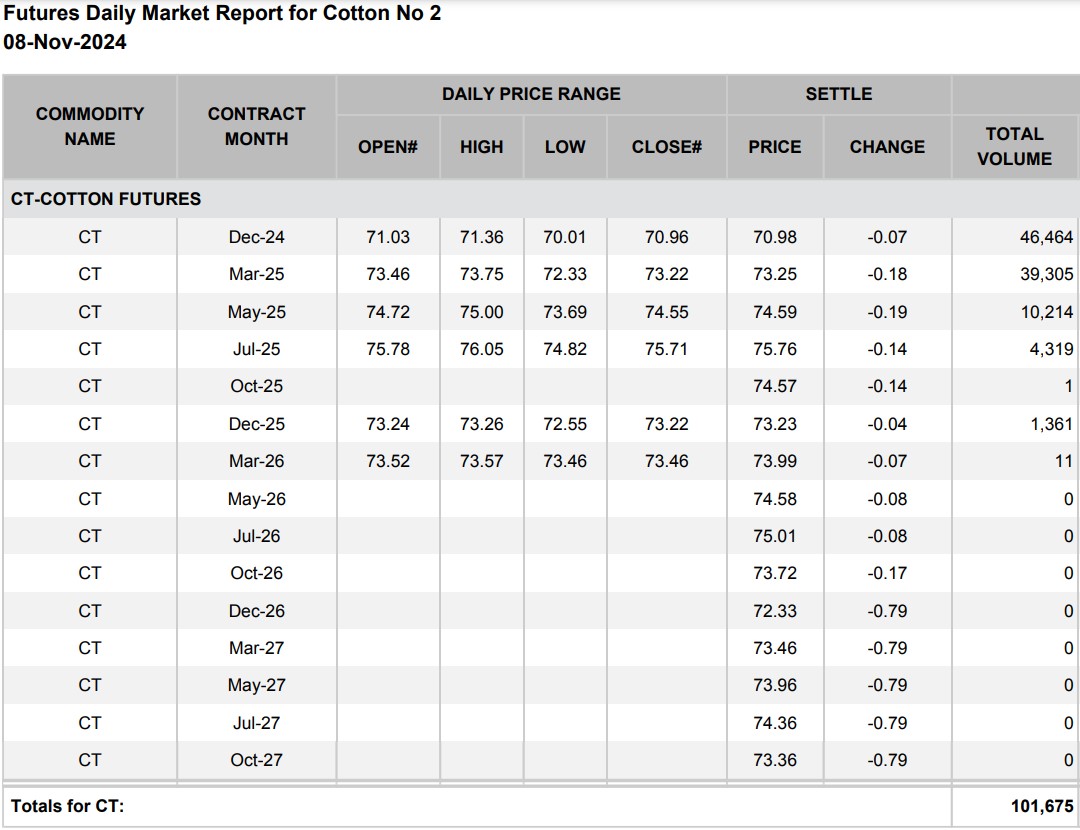
Barchart: Cotton futures were mixed on Tuesday, with contracts closing 22 points higher to 26 points lower. Oct 26 settled at 82.64, up 22 points; Dec 26 at 86.32, down 1 point; Mar 27 at 88.71, up 9 points. Weekly Crop Progress data showed 40% of the U.S. crop with bolls opening as of Sunday and 7% harvested, while condition ratings fell to 34% good/excellent, down 5 points on the week. The Cotlook A index was unchanged on September 7 at 96.00, and the Adjusted World Price was raised another 240 points to 73.92 cents/lb. ICE certified stocks fell 8,678 bales on decertification, to 54,414 bales.
Source: Barchart
U.S. Cotton: Fifth Straight Lower Close as Crude Oil Extends Rally
Calcot: Cotton futures posted a fifth consecutive lower close on Tuesday, though Dec-26 slipped just one point to settle at 86.32 — a cumulative loss of 682 points from its 93.14 contract-high five sessions earlier. Open interest continued edging lower, down 531 contracts, though the modest pace of the pullback raises the question of whether speculators are truly unwinding long positions. Crude oil extended its rally, up 1.7% on the day, as fighting between the U.S. and Iran disrupted Middle East energy supplies, stoking inflation concerns ahead of this week's Producer and Consumer Price Index reports. China's State Reserve logged its 37th consecutive sold-out auction, selling 8,010 tonnes for a 37-day total of 296,736 tonnes. Traders are also awaiting Friday's USDA World Supply/Demand Report.
Source: Calcot
U.S. Cotton: December Hits Contract High Amid Drought Concerns
PCCA: December cotton closed the week of August 31 at 91.38 cents/lb, up 303 points, after touching a new life-of-contract high of 92.75 cents — the second straight week of gains topping 300 points. The rally has been driven mainly by speculative buying rather than fundamentals, with managed-money positioning growing increasingly crowded. Drought conditions worsened for a fourth straight week across the Cotton Belt, with Oklahoma fully affected, Kansas at 98% and Texas at 72%; ginning has begun in South Texas while yield and abandonment risks mount further west. Upland net sales for 2026/27 totaled 95,700 bales, led by Vietnam, Guatemala and Bangladesh, with exports at 181,000 bales. Hawkish remarks from Fed Chair Warsh at Jackson Hole and elevated July inflation data added headwinds for the dollar-sensitive commodity sector.
Source: PCCA
Greece: Normal Correction After Extended Rally
Agronews: Cotton has pulled back after August's sharp rally, with prices near 86.40 cents/lb — still up 8.67% from the low — after peaking near 94 cents late in the month. Analyst Yiannis Papadogiannis attributes the surge to technical, speculative and weather factors rather than physical demand, citing drought damage to crops in Texas and key Chinese growing regions alongside heavy speculative buying across agricultural commodities. He expects further correction as profit-taking continues, noting that Greek ginners are becoming more aggressive sellers and moderating their price demands. Despite reduced acreage, this year's Greek harvest looks promising in volume, though exporters will need sharper pricing to keep sales moving at a satisfactory pace.
Source: Agronews
U.S. Cotton: Crop Progress — Bolls Opening Ahead of Average, Condition Slips
USDA: In the week ended September 6, cotton setting bolls reached 96% across the 15 leading states, in line with the five-year average and up from 89% the week before. Bolls opening stood at 40%, slightly ahead of the 38% average and up sharply from 29% a week earlier. Harvest reached 7%, just above the 6% average. Crop condition slipped to 34% good/excellent, down from 39% the previous week and well below the 54% good/excellent rated at this time last year.
Source: USDA
Spain: Andalusia Cotton Harvest Seen Up 7.3%
Demócrata: Andalusia's Ministry of Agriculture is forecasting a 2026/27 cotton harvest of 120,700 tons from about 45,600 hectares, up 7.3% on the previous campaign. Seville remains the leading growing area with an estimated 89,330 tons, ahead of Cádiz (21,470 tons), Jaén (5,190 tons), Córdoba (4,630 tons) and Huelva (80 tons). Most of the crop is grown under irrigation (around 40,800 hectares), with roughly 4,800 hectares rainfed. More than 36,500 hectares — almost 80% of the total — are certified under Andalusia's integrated production system, which the regional government credits with lowering the crop's carbon footprint and supporting access to agri-environmental aid.
Source: Demócrata
Tanzania: Brazil-Backed Project Boosts Yields for 517,000 Farmers
The Guardian (Tanzania): The Cotton Victoria Project, a $5.8 million Tanzania-Brazil cooperation launched in the 2016/17 season, has reached more than 517,000 farmers across 11 cotton-growing regions as it wraps up. Improved spacing, organomineral fertilizers and better trimming practices have lifted yields from roughly 200-300 kg per acre under old methods to over 1,000 kg per acre; one farmer, Mkama Nyahonge, reached 2,600 kg per acre in 2025/26 and was awarded a 75-horsepower tractor. Output in the eastern growing regions rose from about 800 to 3,800 tonnes a year. Higher earnings have let farmers build better homes and buy livestock and machinery.
Source: The Guardian (Tanzania)
India: EU Emerges as Strategic Growth Market for Apparel Exports
TextileToday: India's apparel exports to the EU hit a record $4.66 billion in FY2025-26, up from $4.55 billion, and are gaining strategic importance now that India and the EU have concluded FTA talks in January 2026 — a deal set to zero out EU duties of up to 12% on a $263.5 billion import market. India's textile exports to Europe rose 9% in FY2025-26 even as U.S.-bound exports fell 7%; Raymond Lifestyle expects Europe to reach 20-25% of its exports within two years, up from 17%, with roughly 30% of European inquiries already converting into orders. Bangladesh, which exported €6.09 billion in apparel to the EU in January-April 2026 (down 19.33%), keeps its duty-free access for now under the Everything but Arms scheme, but stands to lose that edge once it graduates from LDC status — while India's integrated mills are better placed to meet the EU's strict rules-of-origin requirements than non-integrated garment makers.
Source: TextileToday
Uzbekistan: Cotton Picking Begins as Turkiye Eyes Technical Textiles Partnership
Kursiv: Uzbekistan's autumn cotton harvest is beginning as textile exports hit $1.6 billion in the first half of 2026, up 24.1% year-on-year, with a presidential decree targeting garments at 70% of textile exports by 2027. But the article warns this garment-led strategy risks locking Uzbekistan into low-cost, short-term contract manufacturing where buyers hold the leverage. It argues Turkiye — which exported $2.33 billion in technical textiles in 2025 — is a better partner for higher-value products like flame-retardant fabrics, surgical nonwovens and geotextiles, an approach that would let Uzbek engineers build real technical expertise rather than just assembling imported components. Turkiye-Uzbekistan trade reached about $3 billion in 2025, with both sides now targeting $5 billion.
Source: Kursiv
The article summaries were generated using ΑΙ.