
EUR/US$: 1.1258
U.S. Cotton: Friday Bounce Trims a Heavy Weekly Loss
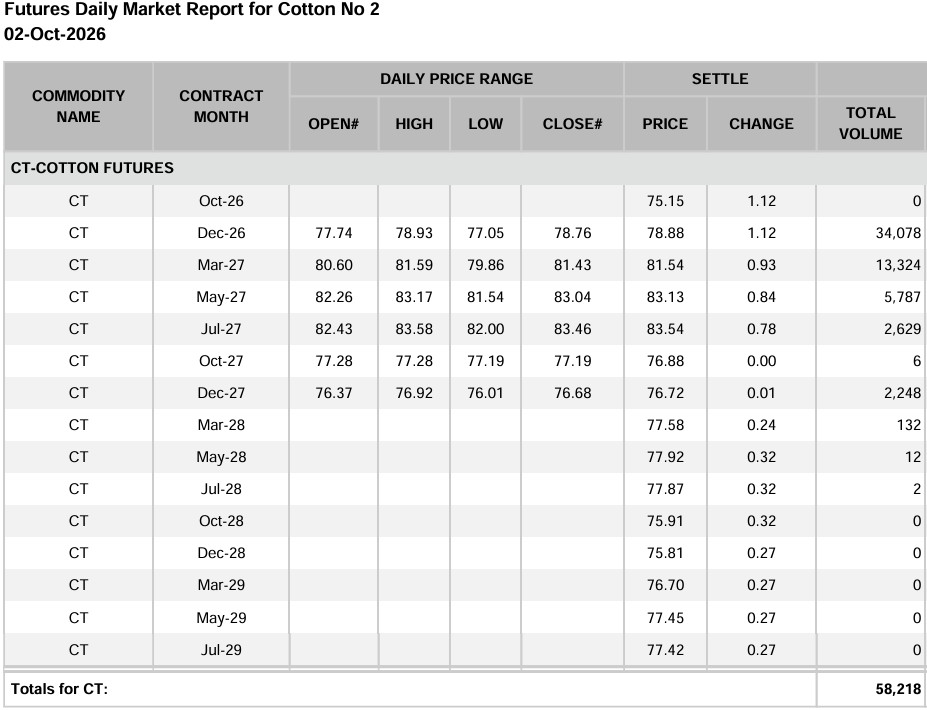
Barchart: Cotton futures closed steady to 112 points higher on Friday, with Dec26 at 78.88 cents (+112 points), Mar27 at 81.54 (+93) and Oct26 at 75.15 (+112). December still finished the week 383 points lower. Crude oil fell about 1.9% on the session and the dollar index eased. Total export commitments stand at 4.937 million running bales, 17% above the same point last year, but that is only 43% of USDA's export projection against an average pace of 51%. The Cotlook A Index slipped 30 points to 89.15 on Thursday, ICE certified stocks were unchanged at 28,017 bales, and the Adjusted World Price is 65.16 cents/lb.
Source: Barchart
U.S. Cotton: A Close Near the Highs, but Fourth Weekly Loss in Five
Calcot (Cindy Walters): December settled at 78.88 cents, just 5 points below the day's high — something for battered bulls to hold on to — yet it lost 383 points on the week and 1,250 points over five weeks. The other 2026/27 contracts fell 4.4% to 4.8% on the week, while the 2027/28 months lost a milder 3.2% to 3.4%. Volume of 58,218 contracts was the lightest of the week. Open interest dropped a further 3,621 contracts to 383,018, the largest daily decline since mid-June; even after shedding 6,476 contracts in two sessions it remains among the highest levels in cotton's history, and Calcot wonders whether this is simply the market's new normal. The latest positioning report showed a fourth straight week of trade buying and speculative selling. The September U.S. jobs report was soft, with payrolls up only 29,000 and unemployment rising to 4.2%, which markets read as reducing the chance of another near-term Fed rate hike. It was a hard week for bulls elsewhere too: corn lost 5.8%, silver 6.8% and gold 3.7%, while the dollar index gained nearly 1% for a third straight weekly rise and crude oil slipped 1.4%, with the U.S.-Iran conflict unresolved despite an Iranian proposal that includes reopening the Strait of Hormuz. Technically, December dipped below its 200-day moving average for a second day after nearly seven months above it, and Friday's gain did little to lighten the roughly three months of resistance overhead. The Dec/March spread narrowed to 266 points. China's ZCE reopens on October 8, and the USDA supply and demand report follows on October 9.
Source: Calcot
U.S. Cotton: Robinson Sees Supportive Signals Beneath a Downhill Week
Texas A&M (John Robinson): ICE cotton slid from the low 80s to the upper 70s over the week, including Tuesday's limit-down move, before a relatively modest bounce took December to 78.88 cents on Friday. Robinson ties Tuesday's fall to the usual determinants — seasonality, weak oil and a strong dollar — combined with negative market news, while Chinese prices and the A Index were mixed and volatile. Upland net sales of 202,600 running bales for the week ending September 24 were slightly below the previous week, and weekly shipments remain under the pace needed to reach USDA's 2026/27 export target. Through September 28, boll opening was running 3 points ahead of the five-year average and harvest 2 points ahead; 35% of the crop was rated good to excellent and another 30% fair. A cool front brought widespread rain to Texas, which is likely to have hurt lint quality. On the supportive side, he notes that falling certified stocks suggest improving demand and that unfixed on-call sales now exceed unfixed purchases, pointing to mill buying ahead — a bullish indicator.
Source: Texas A&M AgriLife
U.S. Cotton: Industry Pushes Tax Incentives to Build Demand
RFD-TV: U.S. cotton groups are pressing Congress to pass the Buying American Cotton Act before the end of the year, a bipartisan proposal that would use tax incentives to encourage the use of U.S. cotton, yarn and fabric in consumer products. Keith Patrick, vice president of Plains Cotton Growers, says the aim is to expand cotton's markets rather than to create another farm safety-net programme. The push comes as growers' margins are squeezed by low prices and by competition from polyester and other synthetics. It sits alongside USDA's Great American Cotton Plan and consumer messaging on natural versus synthetic fibres, with producers encouraged to tell their own stories to connect shoppers with cotton farming. The administration has voiced support for the bill.
Source: RFD-TV
U.S. Cotton: Seventy Years of Asking Whether Cotton Will Survive
Plains Cotton Growers (Kara Bishop): Today's financial pressure on cotton growers is real but not unprecedented, the article argues, drawing on nearly 70 years of West Texas newspaper archives. In 1957 a South Plains headline warned that cotton's survival was at stake, and the Secretary of Agriculture of the day saw only dim hope for its future; in 1960 local papers reported a serious crisis as cotton income fell while production costs rose; in 1963 the message was that costs had to be cut if cotton was to survive; and in 1967 a county paper asked the question that gives the piece its title. Later shocks included the 1998 drought, when about a third of the cotton area around Lubbock failed, and the droughts of 2011 and 2022. The conclusion is that the industry lasted not by simply enduring but by adapting, with each generation adopting new tools — GPS guidance, biotechnology, computerised irrigation — while staying committed to the crop.
Source: Plains Cotton Growers
Indonesia: Support Package for Textiles, but Industry Wants Fair Competition First
Textiles Resources: The Indonesian government is preparing a package to revive its textile and apparel industry, including possible tax holidays, VAT relief on outsourced labour, faster tax refunds for exporters, bank financing for reinvestment and working capital, and a stronger raw-material supply. Coordinating Minister Airlangga Hartarto says the VAT measure follows a request from President Prabowo Subianto and reflects the seasonal swings in export orders that force mills to adjust their workforce. The government also plans to harmonise tariffs between upstream and downstream, tighten controls on illegal textile imports including used clothing, and allow more flexible fixed-term contracts. The sector accounts for about 0.97% of GDP, employs around 4 million people and exports roughly US$12 billion. Redma Gita Wirawasta of the fibre and filament producers' association APSyFI argues that a fair domestic market matters more than new incentives: earlier incentives left the sector stagnant, and tax breaks will do little while local products compete with illegal and dumped imports, complicated licensing and inefficient logistics.
Source: Textiles Resources
India: Karnataka Targets Rs 20,000 Crore of Textile Investment
Textiles Resources: The Indian state of Karnataka has approved a Textile and Apparel Policy for 2026-2031 that targets Rs 20,000 crore of domestic and foreign investment across the textile value chain within five years and five lakh additional jobs. Priority goes to the Kalyana Karnataka region and to smaller tier-2 and tier-3 cities, with 34 talukas eligible for extra incentives and concessions. Silk reeling and silk spinning are now covered by the scheme. Other pillars include stronger regional manufacturing ecosystems, export competitiveness, market linkages, skills development and modern textile clusters, along with handloom revival, promotion of Geographical Indication products, a Centre of Excellence and sustainable practices.
Source: Textiles Resources
The article summaries were generated using ΑΙ.