EUR/US$: 1.1239
U.S. Cotton: Futures Close the Week Mixed
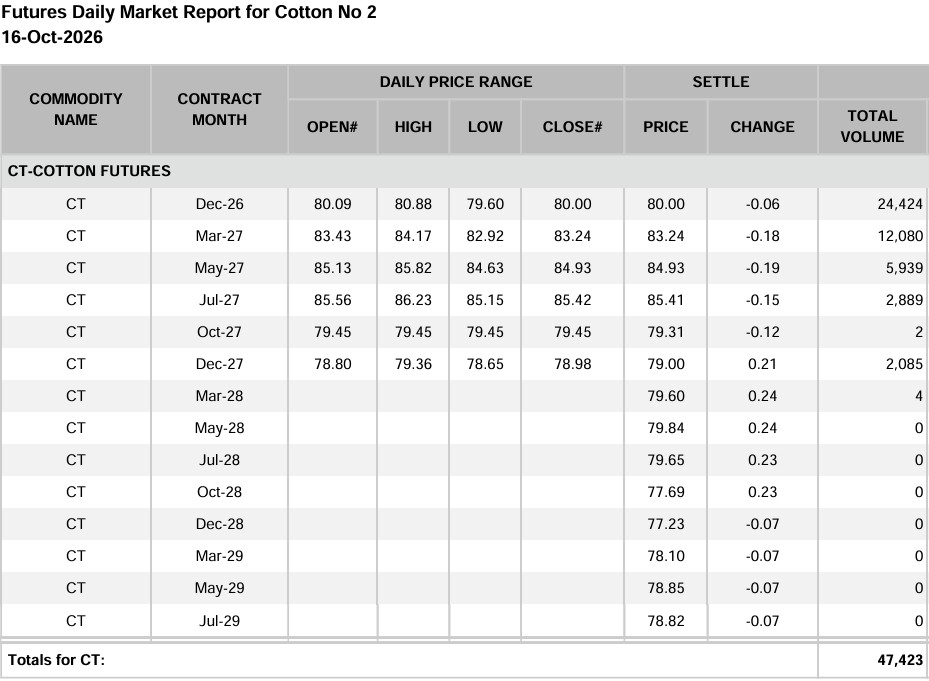
Barchart: Cotton futures ended Friday mixed, from 19 points lower to 24 points higher, with December down 54 points for the week. Crude oil rallied and the dollar eased. In the physical market, The Seam sold 404 bales on October 15 at an average of 73.56 cents/lb, the Cotlook A Index rose 20 points to 91.45 cents, and ICE certificated stocks fell 2,627 bales to 15,129. The Adjusted World Price gained 80 points to 64.61 cents/lb. Dec 26 settled at 80.00 (−6), Mar 27 at 83.24 (−18) and May 27 at 84.93 (−19).
Source: Barchart
U.S. Cotton: Sideways Trade Continues as Open Interest Sets New Record
Calcot – Cindy Walters: December settled at 80.00, down 6 points, extending a nine-session sideways range of 79.23–82.25 cents and losing 54 points on the week. The weekly chart showed a higher high and a higher low, but the settlement below the weekly midpoint (80.82) was a negative. Open interest set a fourth consecutive record at 396,373 contracts, the 23rd record of 2026, and year-to-date volume already guarantees a record year, although fundamental news has been far less impressive. Crude oil jumped 3.5% on the day and 10.4% on the week on Middle East tensions and disruptions in the Strait of Hormuz; costlier oil makes polyester more expensive, which supports cotton. U.S. producer prices rose 1.3% in September, the largest monthly increase since March 2022, while the dollar index posted its first weekly decline in five weeks. The Dec/March spread settled at 324 points March premium, holding above 300 for the first week, a sign of continued December weakness. November options expired, with exercise and abandonment at the 80-cent strike leaning bullish.
Source: Calcot
U.S. Cotton: Weekly Export Sales Weaken
USDA: Net upland sales for 2026/27 totaled 146,900 RB in the week ended October 8, down 11% from the previous week and 12% below the prior four-week average, a weak result. The main buyers were Costa Rica (74,300 RB), India (21,300 RB), Pakistan (19,800 RB), China (8,900 RB, switched from Vietnam) and Turkey (7,800 RB). Sales for 2027/28 were 7,200 RB. Upland shipments fell 13% to 140,600 RB, 9% below the four-week average, mainly to Vietnam (40,800 RB), India (20,100 RB), Bangladesh (12,400 RB), Turkey (10,100 RB) and Mexico (9,100 RB). Pima sales were 10,000 RB and shipments 10,400 RB, mostly to India.
Source: USDA FAS
U.S. Cotton: Weekly Market Summary
TAMU: ICE futures traded flat-to-higher early in the week ending October 16, then turned lower before settling into a narrower range, with December closing at 80.00 cents. Chinese prices were mostly higher and the A Index mixed. Through October 11, boll opening was 1% behind and harvest 2% ahead of the five-year average, with 34% of the crop rated good-to-excellent and 30% fair. Rains across the Cotton Belt are likely to affect grades more than anything else. The drag on futures appears to be lifting: falling certificated stocks may reflect improving commercial demand for U.S. cotton, and unfixed call sales now exceed unfixed call purchases, a bullish sign of potential mill buying.
Source: Texas A&M Cotton Marketing Planner
Global: Is Cotton Winning the Market Share Battle Against Polyester?
Cotton Grower – Beck Barnes: Younger consumers on social media are turning against polyester, using the word as an insult for something cheap, according to recent features in The Guardian, The Business of Fashion and The Atlantic, which point to oversaturation of low-quality garments and health concerns over microplastics. Polyester still accounts for almost 60% of global mill use, but Barnes notes that Cotton Incorporated has long targeted influencers on Instagram and TikTok. Even a 1% gain in cotton's global market share could remove more than six million bales from the world balance sheet, with a significant impact on prices.
Source: Cotton Grower
China: 2027 Cotton Import Quotas Set at 894,000 Tonnes
CCFGroup: China's National Development and Reform Commission will allocate 894,000 tonnes of WTO tariff-rate quotas for cotton imports in 2027, with about 33% going to state-owned enterprises. Applicants must be registered before January 1, 2027, and must be state-owned enterprises, spinning mills with at least 50,000 spindles, or spunlace nonwoven producers with annual capacity above 8,000 tonnes.
Source: CCFGroup
Brazil: Low Liquidity and Divergent Regional Prices
Conab: Brazil's cotton market saw low liquidity in the week of October 5–9, with buyers covering only immediate needs and sellers resisting the prices offered. Producer prices in Mato Grosso fell 1.13% to R$129.05 per arroba, Bahia rose 0.48% to R$139.33, and the São Paulo wholesale price slipped 1.19% to R$137.26. New York first-delivery futures averaged 77.53 cents/lb (+2.54%), while the A Index fell 2.00% to 89.95 cents.
Source: IndexBox
EU–Mercosur: Textile Industries Launch New Dialogue
EURATEX: EURATEX, Brazil's ABIT and Argentina's FITA launched the EU–Mercosur Textile and Apparel Dialogue in Fortaleza on October 15 to support a balanced implementation of the EU–Mercosur Free Trade Agreement. EU–Mercosur trade in textiles and clothing reached almost €700 million in 2025, with EU exports of €495 million and imports of €199 million. The forum will address market access, rules of origin, customs and regulatory barriers, as well as sustainability, traceability and fair competition. It will meet twice a year, with an annually rotating chair.
Source: EURATEX
Brazil: China Top Buyer as Exports Reach 3.37 Million Tonnes
The Bay: China was the largest buyer of Brazilian cotton in 2025/26, taking 23% of exports of 3.374 million tonnes, according to exporters' association Anea, followed by Bangladesh (17%), Turkey (13%), and Pakistan and Vietnam (12% each). Brazil now holds 34% of world cotton exports, up from 7% less than a decade ago. Production fell 2.5% to 4.144 million tonnes as planted area dropped 8% to about 2 million hectares, but yields rose 6% to a record 2,076 kg/ha. Export revenue reached $5.295 billion. Anea expects 2026/27 exports of about 3.4 million tonnes, while Abrapa projects production of 3.8–4.4 million tonnes.
Source: The Bay
The article summaries were generated using ΑΙ.