The challenge facing cotton farmers today is a stable worldwide cotton market where prices aren’t moving drastically either up or down. For the most part, supply and demand are in balance.
Sam Etheridge, chief executive officer of Choice Cotton in Prattville, Ala., explained there is a readily available stable supply of cotton around the world. He said there is strong global demand for cotton, but the demand is being rationed out according to price.
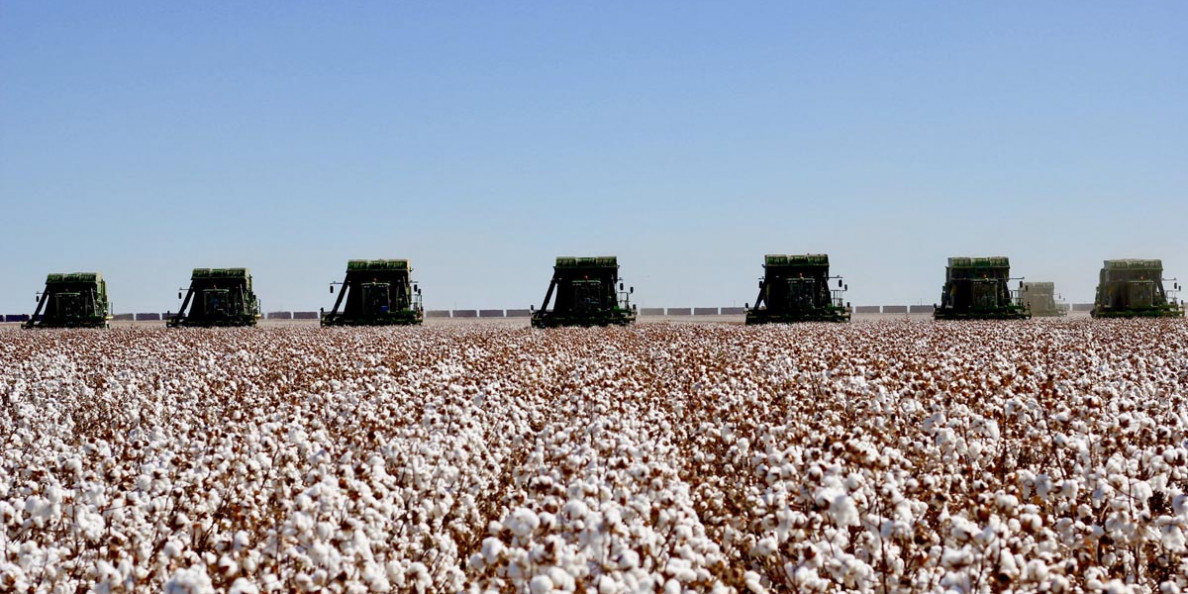
“We are now in a world where a cotton picker is in the field every month of the year with the exception of January and February,” Etheridge said in a Zoom presentation to the Southern-Southeastern annual meeting at the Westin in Hilton Head Island, S.C. Jan. 21.
Cotton from the Southern hemisphere is harvested and delivered between March and September. “What that produces is you just have that steady stream of production. It’s a buyers dream. This adds to that stability,” Etheridge told the gathering of cotton farmers and ginners.
Due to global market stability, Etheridge said cotton prices have remained in a tight range from 63 cents to 68 cents per pound. He doesn’t expect prices to drop below 60 cents per pound or climb above 70 cents per pound.
“We’ve been there a long time. The real question is where can we break out from here? We are looking for something to happen. Can it be something downward? Certainly. This market has been quite resilient against any kind of international disruptions. The downside doesn’t seem to be to be very heavily supported, and the real question is what can push this market higher,” Etheridge said.
Global market
Etheridge emphasized that Brazil, Australia, and China are now driving the global cotton market. China is producing more of its own cotton and reduced its import needs by 2.5 million bales last year. Brazil exported 14.5 million bales of cotton last year compared to 12.2 million bales by the United States.
“The U.S. is now the fourth largest producer. It doesn’t mean we’re irrelevant. I think we will stay relevant as long as everybody trades on ICE (Intercontinental Exchange). But it’s becoming clear that these countries (Brazil and Australia) are more important on the production side,” Etheridge said.
This competition weighs heavily on the competitiveness of U.S. cotton in the global market.
“These guys are here to stay. Australia and Brazil are way outperforming the U.S. China in particular is one big story where they have shifted their production to higher yielding acreage. China is making very productive yields,” he said.
Global cotton consumption is rising, but there is still ample supply to meet demand.
Etheridge said China will remain a net importer of cotton, but they will continue to produce more of their own cotton. He said this is the big story in the global cotton market.
Etheridge emphasized that PLC (Price Loss Coverage) payments and $1 billion in bridge payments from OBBA (the so called One Big Beautiful Act) will provide support to cotton farmers this year. The good news is that PLC payments will be substantially higher in 2026 due to increased reference prices.
OBBA increased PLC payments for seed cotton by 14%, from 36 cents per pound to 42 cents per pound effective for the 2025 through 2031 crop years. Etheridge said this change will benefit farmers experiencing low market prices.
“People are happy to sell in the 66 to 67 cent range. They are getting a positive basis in the Southeast. If they can get close to 70 cents, I think most people are letting go. If you have not let go, then I think the loan is a good tool for you,” Etheridge explained.