Cotton Futures, July 29
EUR/US$ 1.1380
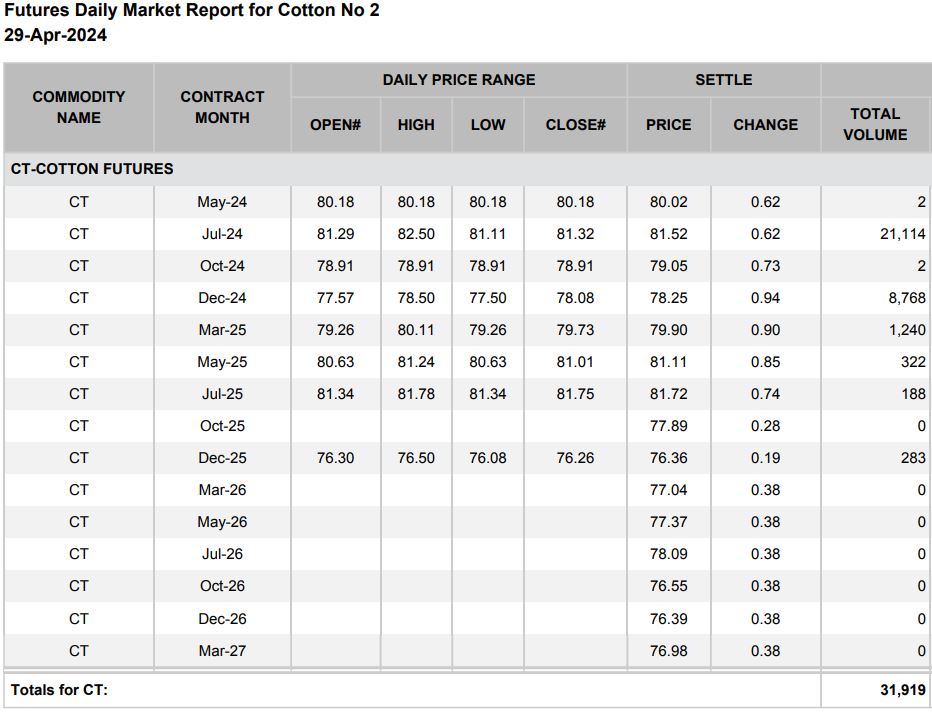
Barchart: Cotton futures were weaker on Wednesday, with front-month contracts down 67 to 119 points, even as crude oil rebounded and the Fed left interest rates unchanged. December closed at 79.53 cents, down 100 points, while October ended at 78.02, down 119. The Cotlook A Index rose 100 points to 90.10 cents, and the Adjusted World Price was trimmed to 63.82 cents/lb. The outlook calls for a drier week in West Texas, with wetter conditions expected in the Delta.
Source: Barchart
ADMIS: Cotton Holds Steady in Choppy Range Amid Dry Weather
ADMIS: December cotton traded lower early Wednesday, staying within Tuesday's range as the market continues its weeks-long sideways pattern, with dry conditions in West Texas keeping traders cautious. The rest of the US crop looks mostly decent, though parts of the Delta and Southeast still need rain. Xinjiang, China is bracing for a ten-day heatwave with highs up to 113°F starting this weekend, while southern India stays drier than usual, even as sowing has picked up pace with the advancing monsoon. India's monsoon rainfall deficit has narrowed to 16% from nearly 40% at the end of June, though the area planted to cotton is still down 4% year-on-year at 9.87 million hectares.
Source: ADMIS
India Wins the US Tariff Battle but Faces a Bigger Global Textile Challenge
Textiles Resources: A new Emkay Research analysis warns Indian textile exporters may struggle to benefit fully from the revised US Section 301 tariffs. India secured a 10% rate, undercutting the 12.5% imposed on China, Vietnam, Brazil and Thailand, but was left out of the tariff-rate quota exemptions given to Bangladesh, Cambodia, Indonesia and Malaysia for goods made with US cotton, leaving Indian exporters paying the full rate while those competitors can enter duty-free. Emkay sees India's export momentum holding up in the near term thanks to the lower comparative rate, but flags ongoing Section 301 overcapacity probes as a risk that could erase that advantage, with much depending on the outcome of India-US bilateral trade talks.
Source: Textiles Resources