
EUR/US$: 1.1590
U.S. Cotton Futures Fall Back on Turnaround Tuesday
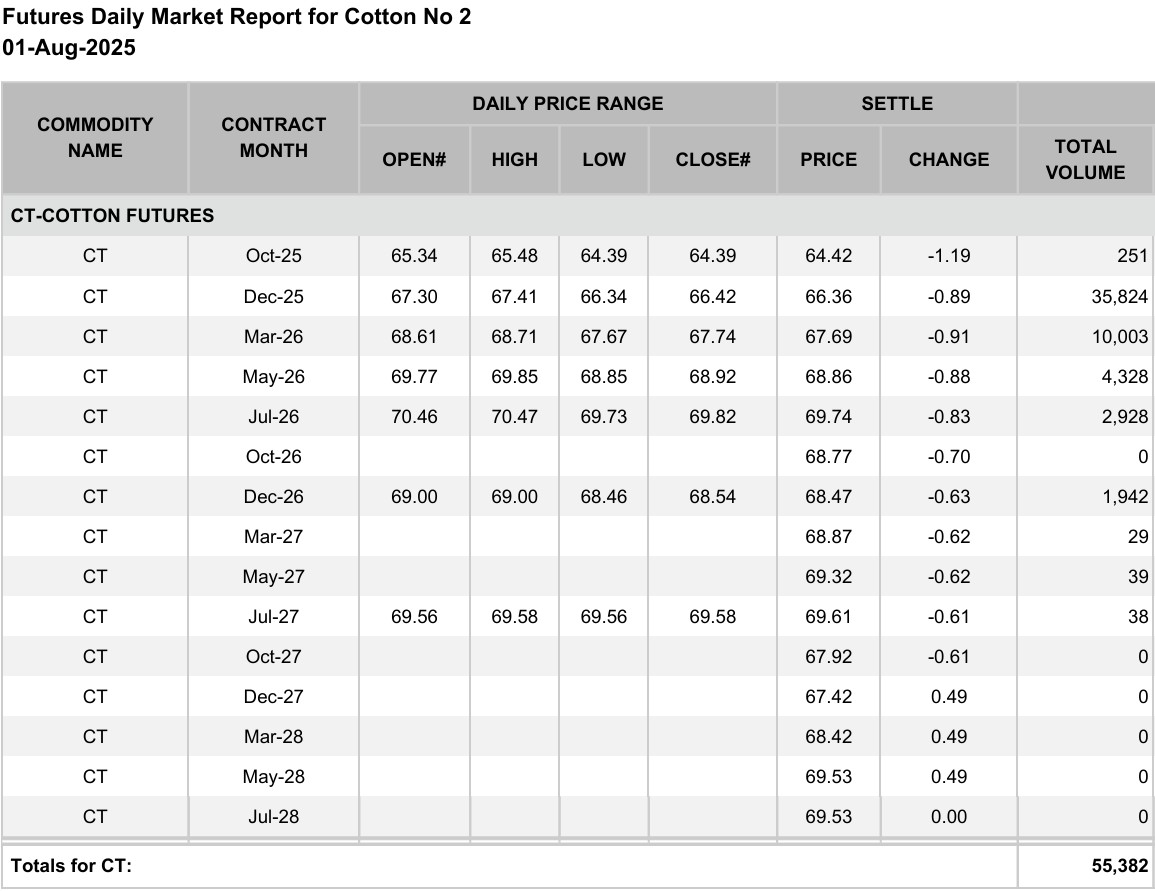
Barchart: Cotton futures gave back Monday's gains on Tuesday, falling 115-169 points across contracts - October settled at 90.01 cents, December at 91.55 cents, and March at 93.68 cents per pound, even as crude oil and the dollar both firmed. The weekly Crop Progress report (as of Sunday) showed 89% of the U.S. crop setting bolls and 29% with bolls opening, with condition still at 39% good-to-excellent, though poor/very-poor ratings rose 3 points and Texas's Brugler500 score slipped further. The Seam saw just 75 bales trade Monday at an average 85.63 cents, and ICE certified stocks held steady at 63,178 bales.
Source: Barchart
ICAC: Global Cotton Production Set to Outpace Consumption in 2026/27
ICAC (Cotton This Month, Sept.): Global cotton production is projected at 26.2 million tonnes for 2026/27, just ahead of estimated consumption of 25.9 million tonnes, though ICAC expects the usual downward revision (production typically eases toward 26.0-26.1 million tonnes as the season progresses, more if weather or pests hit). China's state reserve sales, running since July 20 at roughly 8,000 tonnes per auction, are easing near-term supply, though eventual restocking and Xinjiang weather risk could later push China's import needs higher. India's 2025/26 production was revised up 9% to 5.5 million tonnes and consumption up 7% to nearly 5.9 million tonnes, helped by its five-year Cotton Mission and digital tools reaching over 4.1 million farmers. Pakistan's output is seen falling further, to 1.10 million tonnes in 2026/27, deepening its reliance on imports, while U.S. planted area was revised up 5% to 3.3 million hectares, lifting output to 2.9 million tonnes - even as new U.S. Section 301 tariffs of 10-12.5% reshape sourcing, putting hubs like Vietnam at a cost disadvantage. ICAC's 2026/27 Cotlook A Index forecast ranges 62-99 cents, with a 78-cent midpoint.
Source: ICAC
ICAC: Global Garment Trade Nears $550 Billion as Fiber Competition Intensifies
ICAC (The Textiles Observer, August): World textile exports grew from about $560 billion in 2006 to $914 billion in 2025, with knit and woven garments together making up nearly 60% of that trade. China remains the top exporter, but Bangladesh climbed from 14th to 2nd place and Vietnam from 21st to 3rd since 2006 - together with China the three now account for about 44% of world textile exports. Cotton still leads major apparel categories like T-shirts and trousers, but its share of global fiber demand has fallen from 68.3% in 1960 to 21.1% in 2025 as synthetics rose to 71.7%; cotton also lost share within knit garments (48.3% to 44.5%) and was overtaken by synthetics in woven garments back in 2021. A separate feature in the issue examines cotton contamination from stickiness and seed-coat fragments - defects that can cut prices by up to 50% and raise processing costs - and ways to detect and reduce them from the farm onward.
Source: ICAC
Greece: Deputy Minister Andrianos Visits Thrakika Ekkokistiria
Thrakika.gr: Deputy Minister of Rural Development and Food Giannis Andrianos visited Thrakika Ekkokistiria's offices on August 31, accompanied by Rodopi MP Evripidis Stylianidis and local New Democracy officials. Discussions covered strengthening farm incomes (shaped by product prices, EU subsidies, input costs and yields), restoring the competitiveness of Greek cotton - which has lost ground to U.S. and Brazilian producers in traditional markets like Turkey and Egypt - and raising productivity, currently at just 52% of the EU average, through better capital/technology use, workforce skills and a lighter regulatory environment. The delegation also raised concern that U.S. trade deals, such as with India, secure favorable terms for American cotton that the EU does not match for its own producers. The company said it stands ready to contribute to reviving cotton growing in Thrace.
Source: Thrakika.gr
Brazil Overtakes U.S. as Top Cotton Exporter
Just-Style: Brazil exported 3.37 million tonnes of cotton in the August 2025-July 2026 marketing year, up 19% year-on-year, with revenue up about 9% to $5.3 billion - overtaking the United States (2.66 million tonnes) as the world's top cotton exporter, ahead of Australia (1.24 million tonnes). China was the top destination, taking 770,500 tonnes (23% of exports, up over 300,000 tonnes), while Bangladesh also increased purchases and India's imports rose more than 40-fold in two years; Vietnam and Pakistan bought less. December 2025 was the peak export month at 452,000 tonnes. Brazilian producer group Abrapa expects 2026/27 output to ease to 3.9 million tonnes and exports to 3.1 million tonnes on a smaller harvest.
Source: Just-Style
Ghana Launches Initiative to Revive Domestic Cotton Production
Ecofin Agency: Ghana launched the Northern Cotton Revival Initiative on August 27, a pilot project on more than 20 hectares in Savelugu, backed by roughly €10 million ($11.6 million) in joint financing from the Ghana Export-Import Bank and Germany's KfW. Trade, Agribusiness and Industry Minister Elizabeth Ofosu-Adjare said boosting domestic cotton output would give textile makers more reliable raw material, cut costs and reduce import spending; FAO data show Ghana's seed cotton output has been flat at around 28,000 tonnes on roughly 15,000 hectares since 2020. The push follows the August 28 opening of the Northshore Apparel Ghana factory in Savelugu (50 sewing lines, over 2,300 initial jobs), with future phases envisaging a local cotton-processing unit and outgrower network to complete the value chain from farm to garment.
Source: Ecofin Agency
Europe: Textile Industry Calls for €10 Handling Fee on Ultra-Fast-Fashion Imports
EURATEX (with UFIMH and UIT, from the Premiere Vision event in Paris): Europe's textile industry associations are calling for a €10 per-parcel handling fee on ultra-fast-fashion imports - well above the €2-4 range currently under discussion - to fund customs controls, compliance checks, market surveillance and product-safety enforcement. They argue the lower fees "are unlikely to make a meaningful contribution to the actual costs," which are otherwise borne by taxpayers and by European companies that already comply with the rules. The EU's new €3 duty on low-value imports and the scrapping of the €150 duty-free threshold are welcomed as progress but called insufficient on their own. The groups, representing an industry of 1.3 million jobs and 200,000 mostly SME companies, also want online platforms to take on more responsibility as "Deemed Importers," closing loopholes via bulk imports or fulfilment centers, and equal data access for B2C and B2B flows - building on last year's Villepinte Declaration against ultra-fast fashion.
Source: EURATEX