EUR/US$: 1.1186
U.S. Cotton: Quiet, Mixed Close as Hurricane Isaias Threatens the Southeast Harvest
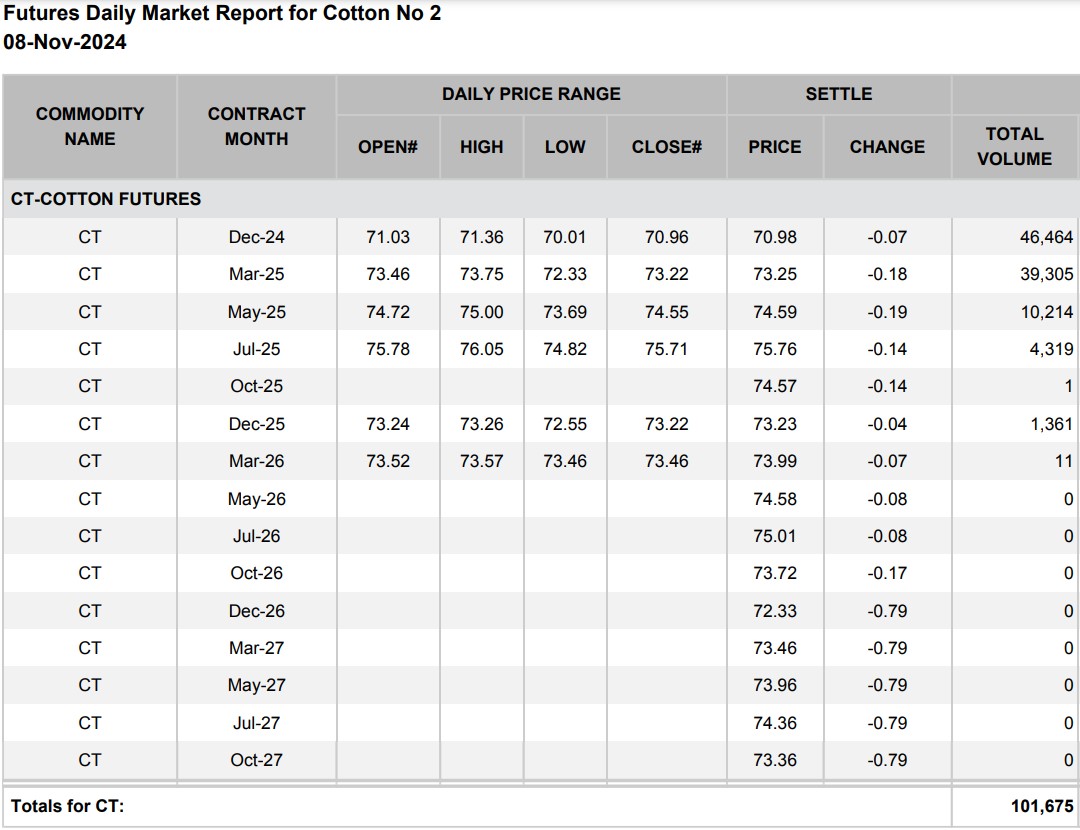
Barchart: Cotton futures closed mixed on Thursday, with the front months 7 to 9 points lower and deferred contracts 6 to 12 points higher: Dec26 settled at 79.94 cents (-9 points), Mar27 at 83.03 (-9) and Oct26 at 76.21 (-9). Crude oil rose about 3.6% while the dollar index eased. Harvest may be slowed in parts of the Southeast over the weekend as Hurricane Isaias brings 2 to 5 inches of rain across much of the region from the Mississippi River to the Atlantic. The Seam reported sales of 1,421 bales on Wednesday at an average of 75.75 cents/lb. The Cotlook A Index rose a further 25 points to 91.70, ICE certified stocks were unchanged at 17,756 bales, and the Adjusted World Price fell 135 points to 63.81 cents/lb.
Source: Barchart
U.S. Cotton: A Bland Session Ahead of Friday's USDA Report
Calcot (Cindy Walters): Cotton eased further from Tuesday's highs, but settlements were within a few points of unchanged in a bland session ahead of Friday's USDA supply and demand report. December settled at 79.94 cents, down 9 points; its 106-point week-to-date gain is the smallest on the board, a relative weakness that is not encouraging for bulls. Volume of 40,731 contracts was among the lightest of the year, while open interest rose 1,948 to 384,176, still close to the record set on September 29. Calcot called the weekly export report modest, with combined net sales for all crop years of 224,404 bales, led by Vietnam, Pakistan and China, and total 2026/27 commitments at 5.30 million bales against 1.59 million shipped. Cotton found little help outside: grains and most stock indexes fell, and crude oil jumped 3.6% after renewed attacks on shipping near the Strait of Hormuz and as Hurricane Isaias threatened Gulf production. China's ZCE reopened after Golden Week, with January cotton closing 1.0% above its September 30 level. Technically, December again failed to settle above its 10-day moving average (80.16), and the Dec/March spread held above 300 points for the first time, at 309 points March premium. The latest on-call report showed unfixed mill sales exceeding unfixed producer purchases for a ninth straight week. With December back below 80 cents, the daily trading limit returns to 300 points from October 9.
Source: Calcot
U.S. Cotton: Weekly Sales Ease but Stay Above Average, With China Buying Next Season
USDA: Net sales of upland cotton for 2026/27 totalled 165,100 running bales in the week of September 24 to October 1, down 19% from the previous week but 14% above the prior four-week average — a satisfactory result. The main buyers were Vietnam (61,800 RB), Pakistan (45,900), India (20,800), Honduras (11,900) and Bangladesh (8,100), partly offset by cancellations from China (7,400). Sales for 2027/28 reached 56,100 RB, of which 44,100 went to China, with Honduras (10,400) and Japan (1,600) taking the rest. Shipments of 161,600 RB were up 8% from the previous week and 2% from the four-week average, going mainly to Vietnam (39,600 RB), India (18,100), Mexico (17,900), Pakistan (16,500) and Guatemala (14,500). Pima net sales were 3,300 RB, mostly to India, while Pima shipments fell 69% to 2,900 RB.
Source: USDA
China: Cotton Prices Under Pressure Despite Firm Seed Cotton After Golden Week
CCFGroup: ZCE cotton is expected to trade in a range, supported by firm seed cotton costs but held back by weak downstream demand, a softer basis and hedging pressure. Futures fell sharply on September 29-30 before the National Day holiday, pulling Xinjiang seed cotton prices down to lows of about 7.1-7.2 yuan/kg, before they rebounded during the break: on October 8, machine-picked seed cotton with a 38% ginning outturn traded at 7.35-7.6 yuan/kg, with cottonseed at 2.5-2.6 yuan/kg. That puts the theoretical cost of most new-crop lint at 16,400 yuan/tonne or more, generally below 17,100, while heavy hedging is expected above 16,000 yuan/tonne. On the macro side, ZCE cotton had fallen nearly 2,000 yuan/tonne after the September Fed hike, and the US$30 billion reciprocal tariff-reduction deal excluding China's cotton textile and apparel exports renewed pessimism. Basis for new-crop North Xinjiang 3129 cotton is mostly CF01 +1,200 yuan/tonne or higher and is expected to weaken as supply grows. Mills remain cautious, with thin orders despite the peak season, and ginners report lower outturns, prompting downward revisions to production estimates.
Source: CCFGroup
Vietnam: Textile and Apparel Exports Up 3.3% in Nine Months, With Yarn Leading Growth
Textiles Resources: Vietnam exported US$35.72 billion of textiles and apparel in January-September 2026, 3.3% more than a year earlier. Garments accounted for $28.24 billion, up 2.2%, while fibres and yarns grew fastest, up 13.08% to $3.61 billion, and non-woven fabrics rose 7.77% to $610 million. The industry faces unpredictable conditions, however: VITAS vice president Truong Van Cam notes that Vietnamese textiles and garments face a 12.5% tariff in the United States, their largest market, against 10% for some competitors, which could hurt prices, order retention and market share as production and logistics costs rise. Raw-material, spare-parts and transport costs are climbing and fabric deliveries are being delayed. Some knitting firms have orders to the end of the year, but many garment makers are still slow to finalise fourth-quarter orders, and companies are shifting from volume to higher-value orders with better terms.
Source: Textiles Resources
China: Researchers Find the Genetic Switch Behind Cotton's Fibre-Versus-Seed Trade-off
EurekAlert!: Cotton breeders have long faced a trade-off — improving fibre elongation tends to reduce seed oil and vigour, and vice versa — and a team from Zhengzhou University and the Institute of Cotton Research of the Chinese Academy of Agricultural Sciences has now identified a molecular pair behind it, published in Science China Life Sciences. The gene GhRCD1 promotes fibre elongation but suppresses seed vigour, while GhMYC3 does the opposite. During the first 20 days after flowering, GhRCD1 is abundant in the fibres and binds GhMYC3, switching on genes that balance reactive oxygen species and produce the fatty acids that drive fibre growth; after day 20 GhRCD1 declines, freeing GhMYC3 to redirect resources towards seed oil, vigour and a softer seed coat. The researchers, who used CRISPR gene editing, describe the module as a timing mechanism rather than a simple on-off switch, and propose boosting GhRCD1 only in fibres, or adjusting GhMYC3 only in seeds, to improve one trait without sacrificing the other. Field trials are still needed before the findings can reach commercial varieties.
Source: EurekAlert!
Africa: Turning Cotton Fibre into Fashion
New African (Neil Ford): Africa is a major supplier of raw cotton but captures little of the value added further down the chain, and the article argues it should build domestic spinning, weaving, dyeing and garment industries — progress, it says, should be measured in value captured rather than tonnes harvested. ICAC puts world lint production at about 26 million tonnes in 2025/26, with 9.7 million traded. USDA projects Mali and Benin as Africa's leading producers at about 261,000 tonnes of lint each, followed by Cameroon (142,000), Burkina Faso (133,000) and Côte d'Ivoire (121,000). Benin shows the dependence on raw exports: of $500.9 million of cotton shipped in 2024, $480.4 million went to Bangladesh. The country is trying to build a farm-to-fashion chain through the Glo-Djigbé Industrial Zone, while Ethiopia aims to expand both cotton and textiles. Competing with established Asian clusters requires reliable power, competitive finance and skilled labour, but growing fashion markets in Nigeria, Ghana, South Africa and Kenya, the 1.4 billion-strong AfCFTA market and brands' demands for traceability could work in Africa's favour.
Source: New African
Global: Fashion for Good Project to Scale Up Recycled Cotton Yarns
Texdata: Fashion for Good has launched the Cotton Reloop Matrix Project with Arvind, BESTSELLER, C&A, Interloop, Reformation and Shahi, with Uster providing spinning and yarn-testing expertise, to map and physically test commercially available recycled cotton yarns against brand specifications. Mechanical recycling is the only route that returns cotton as cotton, but shredding shortens and weakens the fibre, so only 45-50% of the input survives as usable material and most yarns are capped at around 10% recycled content before fabric becomes insufficiently durable. Testing is fragmented, and brands often judge recycled blends against 100% virgin cotton standards; the project instead argues for "fit for purpose" uses. It will build a quality matrix of what recyclers can supply against what brands need, produce 10 demonstrator fabrics and five quality-improvement trials in real production, and publish an open-source spinning procedure and a roadmap for cotton circularity. Cotton accounts for 19% of global fibre production.
Source: Texdata
The article summaries were generated using ΑΙ.