
EUR/US$: 1.1188
U.S. Cotton: Little Changed in a Narrow Range
Barchart: Cotton futures closed Tuesday 9 points lower to 6 points higher, with Dec26 at 80.51 cents (-9 points), Mar27 at 83.83 (+2) and May27 unchanged at 85.48. Crude oil edged up about 0.4% while the dollar index fell. The Seam reported sales of 836 bales on Monday at an average of 77.22 cents/lb. The Cotlook A Index rose 50 points to 91.15, ICE certified stocks were steady at 17,756 bales, and the Adjusted World Price stands at 63.81 cents/lb.
Source: Barchart
U.S. Cotton: Open Interest Hits a New All-Time High in a Sideways Market
Calcot (Cindy Walters): Cotton stayed in its week-long sideways range, with December settling at 80.51 cents, down 9 points after Monday's 6-point gain, and the rest of the board 10 points lower to 6 points higher. The bland trade has not discouraged participation: open interest reached a new all-time high of 393,020 contracts, up 3,697 and above the previous record of 389,494 set on September 29, with most of the increase in March. Calcot notes that the yearly high for open interest has never exceeded 323,000 contracts before this year. The lack of direction coincides with two industry gatherings this week, the International Cotton Association's trade event in Istanbul, expected to draw more than 600 delegates, and the Textile Exchange Conference in Vancouver. Crude oil posted a fourth straight gain on renewed Houthi attacks on Saudi Arabia and concerns over the Strait of Hormuz, while the dollar index fell 0.4% ahead of Wednesday's U.S. inflation data. December closed above its 10-day moving average for a third straight session — the first time since September 1 — but the Dec/March spread widened again to a record 332 points March premium, and December's loss of leadership continues to trouble bulls. November options expire on Friday.
Source: Calcot
U.S. Cotton: Harvest at 31% and a First Small Gain in Condition
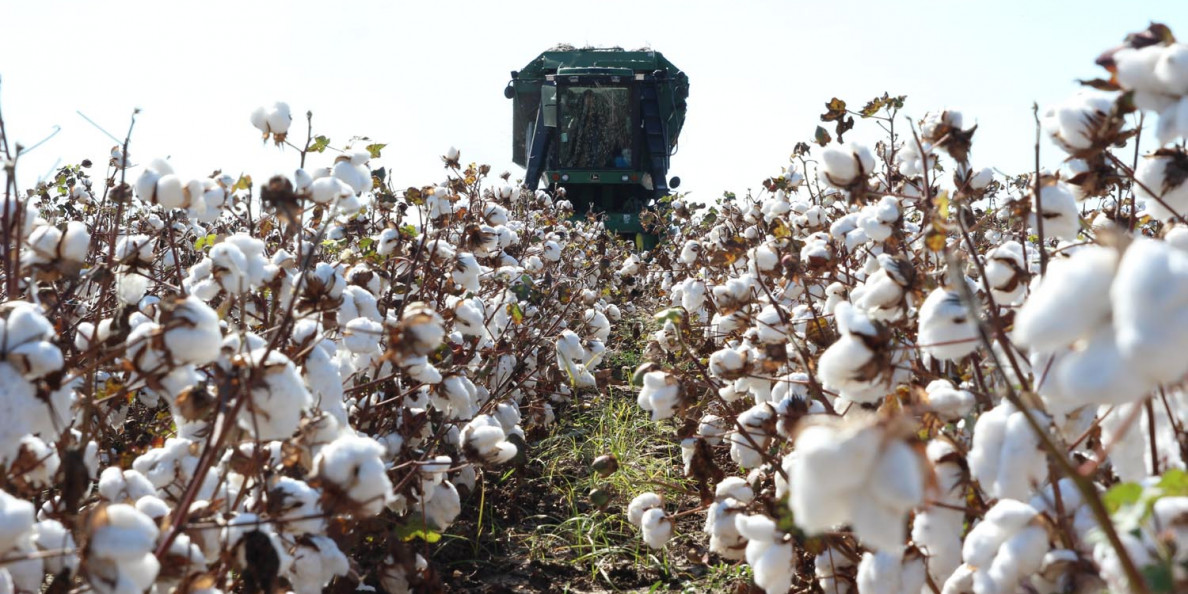
USDA: As of October 11, bolls were open on 82% of the U.S. cotton crop, up from 74% a week earlier and almost in line with the five-year average of 83%. Harvest reached 31%, against 23% the previous week and a five-year average of 29%. Crop condition improved slightly, with 34% rated good to excellent, up from 33%, and 36% poor to very poor, down from 37%. In Texas, 75% of bolls were open (average 76%) and 38% of the crop harvested (average 34%), with 19% rated good to excellent and 52% poor to very poor. The report was released a day late because of the Columbus Day holiday, and year-ago comparisons are not available.
Source: USDA
China: Seed Cotton and By-Product Prices Firm as Xinjiang Harvest Accelerates
CCFGroup: More than half of Xinjiang's cotton has now been harvested: northern Xinjiang has picked over 70% and should finish after October 20, while machine picking in the south, at around 30-40%, is ramping up and should conclude in early November. Seed cotton prices dipped during the National Day holiday to lows of about 7.1-7.2 yuan/kg for machine-picked cotton, but have kept rising since: premium machine-picked seed cotton with a 38% ginning outturn is at 7.4-7.6 yuan/kg, higher grades above 7.7, and hand-picked cotton about 8.4 yuan/kg — roughly 1.3-1.4 yuan/kg above a year ago. Yield losses of about 50 kg/mu in the north and 20 kg/mu in the south, along with reduced planted area, have ginners worried that output will fall short of expectations; they have stepped up purchases, well ahead of last year's pace, while farmers are reluctant to sell at low prices and some regions show mild competition among buyers. Cottonseed is at 2,550-2,600 yuan/tonne, far above last year's low of 2,100, and refined linter at 4,300-4,400 yuan/tonne in Xinjiang, about 1,200 yuan above a year ago. CCFGroup expects concerns about tight 2026/27 supply to lift the price benchmark for cotton and its by-products.
Source: CCFGroup
Brazil: Bayer Highlights Fibre Quality and New Uses for Brazilian Cotton
Revista Cultivar: Ahead of the Brazil 2026 International Congress in Fortaleza on October 14-15, Bayer says innovation in the field is one way to raise cotton quality and meet the textile industry's growing demand for more sustainable and functional raw materials. With Conab forecasting more than 4.1 million tonnes of lint in 2025/26 and Brazil keeping its lead in world exports, Bayer's cotton business director Fernando Prudente says the country combines scale, technology, efficiency and high fibre quality, and that the company supports growers with a tailored portfolio at every stage. The company also points to research supporting cotton's functional advantages, including a Ghent University study showing that polyester gym clothes encourage the bacteria behind sweat odour while cotton inhibits them, and medical recommendations favouring cotton for its breathability, alongside its renewability and biodegradability.
Source: Revista Cultivar
Mexico: Wild Cotton in Yucatán Holds Genes Modern Varieties Have Lost
Harvest Public Media / KOSU: A study in the Proceedings of the National Academy of Sciences, led by Iowa State University's Jonathan Wendel and Corrinne Grover with 20 authors from the U.S., Mexico, Europe and China, has confirmed the Yucatán Peninsula as the place where upland cotton — about 90% of the cotton grown today — was domesticated roughly 5,000 years ago. Sequencing hundreds of samples and comparing them with thousands of existing ones, the team found that two random wild plants carry on average twice as many genetic differences as two modern cultivars, showing how much diversity domestication has stripped out — potentially including resistance to certain diseases or tolerance of salty soils. Wild Yucatán cotton grows as woody perennial shrubs near sand dunes, with short, coarse tan fibre. Texas A&M breeder David Stelly says breeders want yield, pest and disease resistance and heat and drought tolerance, which matters on the Texas High Plains as the Ogallala Aquifer declines, and the researchers warn that wild populations are threatened by development.
Source: KOSU
Turkey: Orta Anadolu Closes Its Historic Denim Mill After 73 Years
Textiles Resources: Orta Anadolu Ticaret, one of Turkey's best-known denim producers, stopped all manufacturing at its Kayseri site on October 12. Founded in 1953, the company became from 1986 one of the leading denim suppliers to international brands, its fabrics used by Levi's, Lee, Mavi and Calvin Klein, and was widely seen as a benchmark for the sector for its investment in sustainability, fabric development and high value-added production. Management blames a worldwide downturn that has made the existing business model untenable — weaker overseas demand, steeply higher borrowing and operating costs, and tougher competition. Industry voices have warned for two years that Turkish producers are squeezed by weakening European demand, high energy and labour costs and rising competition from the Far East and North Africa, and the closure is seen as one of the starkest signs yet that these pressures are reaching even the sector's strongest, high-value operators. Several hundred employees saw their contracts ended, with statutory entitlements to be paid by November 7.
Source: Textiles Resources
Global: Fibre Output Hits 139 Million Tonnes as Fossil-Based Polyester Drives Growth
Textiles Resources: World fibre production rose 5.3% to an estimated 139 million tonnes in 2025 from 132 million in 2024, according to Textile Exchange's Materials Market Report 2026, with virgin fossil-based fibres accounting for about 71% of the growth as they climbed from around 81 to 86 million tonnes. Polyester remained dominant at 82.5 million tonnes, a 59% share, of which virgin fossil-based material was 72.8 million tonnes, close to 88%. Recycled polyester rose only slightly, from about 9.4 to 9.7 million tonnes, and 97% of it came from plastic bottles; recycled material from textile-to-textile routes made up just 0.76% of all fibre production. Cotton held second place at 25.7 million tonnes, with man-made cellulosics at about 7% of output. Among the 384 brands and retailers in Textile Exchange's benchmark, recycled polyester rose to 76% of their polyester sourcing, but they could not name the country of origin for 79% of their raw materials, pointing to persistent traceability gaps.
Source: Textiles Resources
The article summaries were generated using ΑΙ.