EUR/US$: 1.1208
U.S. Cotton: Futures Fade Lower Despite Supportive Outside Markets
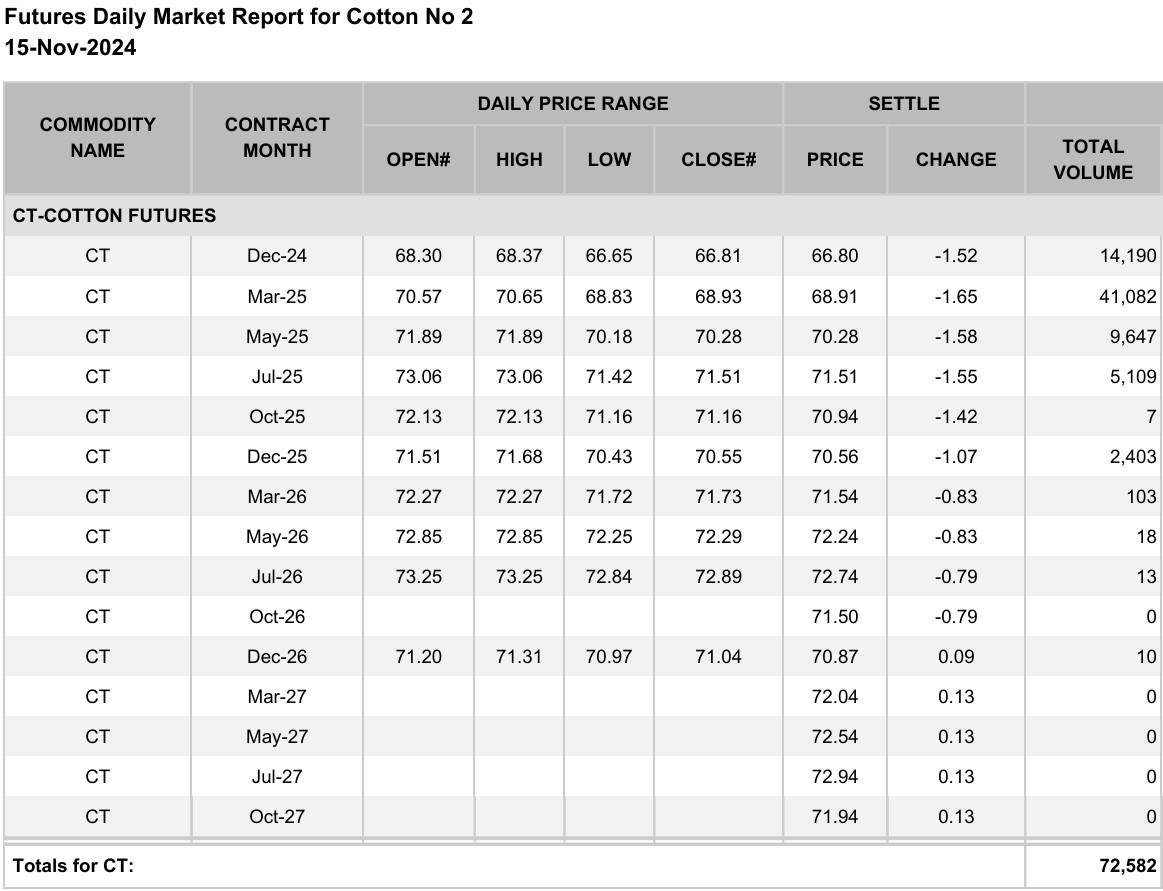
Barchart: Cotton futures ended Thursday 24 to 60 points lower, despite support from outside markets, with crude oil rallying and the U.S. dollar weakening. In the cash market, The Seam reported 3,109 bales sold on Wednesday at an average of 76.59 cents/lb. The Cotlook A Index was steady at 91.25 cents, ICE certified stocks were unchanged at 17,756 bales, and the Adjusted World Price rose 80 points to 64.61 cents/lb. December closed at 80.06 cents (−60), March at 83.42 (−58) and May at 85.12 (−57).
Source: Barchart
U.S. Cotton: December Slips to the Bottom of Its Eight-Session Range
Calcot: December settled at 80.06 cents (−60), at the low end of the 79.23–82.25 cent range it has traded in over the last eight sessions, and back below its 10-day moving average; the week-to-date loss stands at 48 points. Inflation worries resurfaced after September producer prices jumped 1.3%, the biggest monthly rise since March 2022 (6.3% year on year), although the dollar index fell 0.5%. Crude oil gained about 3% for a sixth straight higher close, helped by a large draw in U.S. inventories and continued attacks on shipping near the Strait of Hormuz. Open interest set its 22nd record of the year at 396,007 contracts, and the Dec/March spread widened again to 336 points March premium. CFTC data showed on-call sales exceeding on-call purchases for the tenth consecutive week. November options expire today.
Source: Calcot
Global: Overview of the World Cotton Market (ICA Special Feature)
Cotton Outlook – Alice Robinson: The Cotlook A Index has swung in a range of almost 30 cents over the past year, from a February low of 72.55 cents/lb to a peak of 102.30 cents in early September, its first move above a dollar in almost two and a half years. The war in the Middle East initially pushed prices down, but the subsequent rise in oil made polyester more expensive, narrowing the price gap between the fibres to its smallest since 2022 and prompting many mills to use more cotton. Smaller crops in the U.S. (drought in Texas), India (patchy monsoon) and possibly Xinjiang (extreme heat), together with a sharp turn in speculative positioning, added to the rally. Brazil, the cheapest origin for most of 2026, made basis levels far more volatile. Mills keep buying hand-to-mouth, with cover of only about a month, but volumes have added up: India imported almost 1.13 million tonnes in 2025/26 (+70%), and China’s State Reserve sold more than 350,000 tonnes from July, raising expectations of restocking imports. Cotlook projects 2026/27 world output at 25.4 million tonnes (−6.3%), including a U.S. crop of 2.78 million tonnes, against consumption of about 26.4 million tonnes, cutting world stocks by about one million tonnes.
Source: Cotton Outlook
Brazil: StoneX and Cotlook Launch a Brazil Basis Swap (ICA Special Feature)
Cotton Outlook – Ariel Coelho & Valentin Olah (StoneX): Brazil has moved from a regional supplier to one of the most influential origins in world trade, thanks to investment in technology, genetics and large-scale production in the Cerrado, especially Mato Grosso and Bahia, and it now supplies cotton for a much larger part of the year, with more consistent quality and stronger traceability. As Brazilian prices increasingly set what mills pay, buyers and merchants face greater basis risk on that origin. To address it, StoneX and Cotlook have formed an exclusive partnership to develop over-the-counter derivatives on the Cotlook price series, starting with a Brazil basis swap. Coelho notes that Brazil’s production and exports have now overtaken those of the U.S., while only U.S. cotton can be delivered against ICE futures: the swap lets participants transfer the basis risk that futures cannot cover, while still using ICE to hedge the main price component.
Source: Cotton Outlook
Türkiye: Cotton Output Heads for a Low of 480,000–500,000 Tonnes (ICA Special Feature)
Cotton Outlook – Barış Kocagöz (Izmir Commodity Exchange): Rising domestic costs that the weaker lira has not offset have cost the Turkish textile industry its price competitiveness, cutting capacity utilization from as high as 90% to 65–70% and keeping mill purchases of local cotton sluggish for two years. Combined with low world prices, last season’s drought and subsidies rising far below inflation, this has pushed growers toward wheat, barley, sunflower and corn. Production, which peaked at 1.1 million tonnes in 2022/23 and fell to around 650,000 tonnes, is expected to bottom out this season at 480,000–500,000 tonnes, with mills covering the gap through imports averaging about one million tonnes a year. This season there has been no drought and yields are expected to improve; Kocagöz expects output to recover from these lows as world prices rise, and highlights a project to promote Turkish cotton as a GMO-free brand.
Source: Cotton Outlook
Europe: Agricultural Resilience at a Critical Point, Bayer-Commissioned Report Says
Ypaithros: A report by Oxford Economics, commissioned by Bayer, warns that the EU and UK risk falling behind the U.S., Brazil, China and Canada unless farmers get faster access to innovation. EU agricultural output grew by just 0.1% a year in 2011–2023, against 1% in the U.S., 3.3% in Brazil and a global average of 2%. Climate-related losses already average €17.4 billion a year, or 6.4% of EU production, and could reach €24.8–28.9 billion by 2050. The number of approved active substances in the EU has fallen from over 1,000 in the early 2000s to about 420, with 92 lost in the past seven years and only one new synthetic plant protection product approved. In a survey of over 8,000 consumers in eight countries, 84% said food security is a matter of national security and 84% that farmers should have access to the latest technologies.
Source: Ypaithros
U.S. Cotton: Record ARC and PLC Payments Expected by End-October
AgWeb: USDA has announced about $13.8 billion in gross ARC and PLC payments for the 2025 crop, the largest since the programs began under the 2014 Farm Bill, and payments are expected by the end of October, with some farmers already paid. University of Illinois economists (farmdoc daily) estimate seed cotton payments at $119 per base acre, while farm accountant Paul Neiffer puts total cotton payments at about $1.5 billion. Payments were boosted by the higher reference prices and wider ARC coverage introduced by the One Big Beautiful Bill Act, though payment limits and the 5.7% sequestration cut will trim the final amounts. Enrollment for 2026 closes on December 11.
Source: AgWeb
Africa: Can Cotton Power Industrialization?
African Business, via AllAfrica: Africa’s 37 cotton-growing countries produce 6.3–8.5 million bales a year, or 7–10% of world output, but about 70% is exported as raw fiber; the continent spends about $50 billion a year on textile imports while earning around $15 billion from raw cotton exports. Mali (about 1.3 million bales) and Benin (1.2 million) lead production, followed by Côte d’Ivoire, Cameroon and Burkina Faso. Under the Partnership for Cotton, launched in 2024 by six producing countries with the WTO and UNIDO, the goal is to raise local processing from 2% today to 25% by 2035, with $5 billion of new investment, creating about 500,000 jobs; implementation began in March 2026, with Afreximbank supporting financing and industrial zones in Benin, Cameroon, Chad and Mali.
Source: AllAfrica
Indonesia: State to Consolidate and Revive Closed Textile Mills
Textiles Resources: Indonesia plans to create a state-owned textile group by absorbing several domestic manufacturers, including the bankrupt Sritex, with about $6 billion reportedly earmarked to strengthen the sector. Industry Minister Muhammad Sarmuji said the plan has been raised with the Danantara sovereign investment agency, aiming to pool capacity and know-how, tighten supply chains and improve competitiveness. Talks on Sritex continue, pending asset valuation and coordination with its receivers.
Source: Textiles Resources
The article summaries were generated using ΑΙ.