It is difficult to sit in the chair today, with December futures trading at 75-76 cents. I have procrastinated as long as I can in trying to get the market above 80 cents. I again suggest growers seek protection on any movement above the 79-80 cent level.
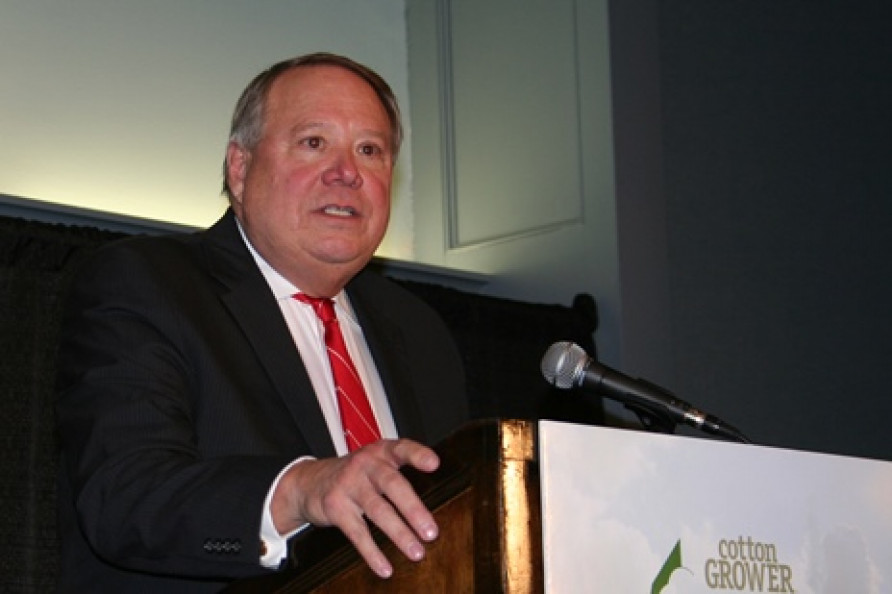
It is with heavy heart that I inform you that this will be my final weekly cotton market report. I have published Cotton Marketing Weekly for more than 50 years. It would not have been possible to maintain this longevity without the unwavering support of Mississippi State University, Farm Bureau, National Cotton Council of America, the U.S. cotton producer, and a host of other industry supporters. A special recognition goes to the late Joe O’Neill, President of the New York Cotton Exchange, who provided much mentoring. I truly thank my colleagues for putting up with me.
Finally, thanks go to my family for their daily support. It is time for me to step away. My weekly reports have been a labor love for the economic synergies that have placed the United States among the most important textile chain participants in world agribusiness. No doubt success will continue to excel long after I have stepped away. More importantly, the American cotton producer has a well-lit path to achieve even greater success.
Speculators have stepped away from cotton trading, causing daily trading volume and open interest to plummet. They will return, but their participation will depend on crop size and demand. Supply and demand, the fundamentals, determine the price of cotton. However, the technicals provide us a visual road map as to how the market arrives at that price. Too, always remember that technicals are the leading indicator of fundamentals. Speculators are on the sidelines waiting to come back to the market either as buyers or sellers. They will be a major player in pushing prices higher or lower.
The market regards cotton demand as fixed; thus, the only variable in price determination is supply. Consequently, Mother Nature controls the market just now. If she can provide adequate moisture in a handful of areas, the crop will grow and pressure the December contract as low as 70 cents. Yet without her favorable growing conditions the market is set to challenge the mid-80-cent level or even higher should a production disaster occur in one of the four leading world producers: China, India, Brazil, and the U.S. That scenario is not expected, but it is too early to make that determination.
With December futures treading water at 76 cents, the market is telling us that it is more concerned about the crop getting better. Should prices move back to the 79-cent level, the signal it will be sending is that market participants feel crop conditions are beginning to deteriorate. Each two-cent increase from there indicates an extremely grave concern over crop conditions. It is a breakout of this narrow four-cent range that will excite the market, creating increased volume and open interest, thus creating a significant price move, whether it be higher or lower. Yet, for now, prices are stuck in the mud, just backing and filling between 75.50 and 79.50 cents. Direction will be established only when the market breaks out of this range.
U.S. export sales and shipments remain significant enough to ensure the U.S. will export 12.2 million bales during the current season, 2025-26. Primary buyers remain Vietnam, Bangladesh, Pakistan, China, and Turkey. Sales for the coming marketing year, 2026-27, which begins August 1, 2026, and ends July 31, 2027, remain a bit slow, but most mills remain on the sidelines waiting for Mother Nature to tell us more about crop size. A price decline below 73 cents will uncover a bit of buying and could support prices. However, at that level, mills will only be scale-down buyers. A price increase above 78 cents will, at least for now, shut off mill buying. It is expected that 2026-27 mill demand will be unchanged or only slightly higher.
The On Call report is slightly favorable, but only slightly. The difference between December On Call sales versus On Call purchases shows about one million bales more in needed grower sales versus needed mill buying. It is not unusual for this difference to be five million or more. However, I caution you that July to December, in terms of market timing, is light years away. Thus, the On Call situation must be viewed with a jaundiced eye for now.
December goes higher but take 25% price protection at 79 cents. Should prices go higher, just think how much more you will get for the additional 75% of your production.
Two things: Always support the National Cotton Council, it is your organization, and remember–
Give a gift of cotton today!
Dr. O.A. Cleveland is professor emeritus, Agricultural Economics at Mississippi State University.
Πηγή: cottongrower.com