
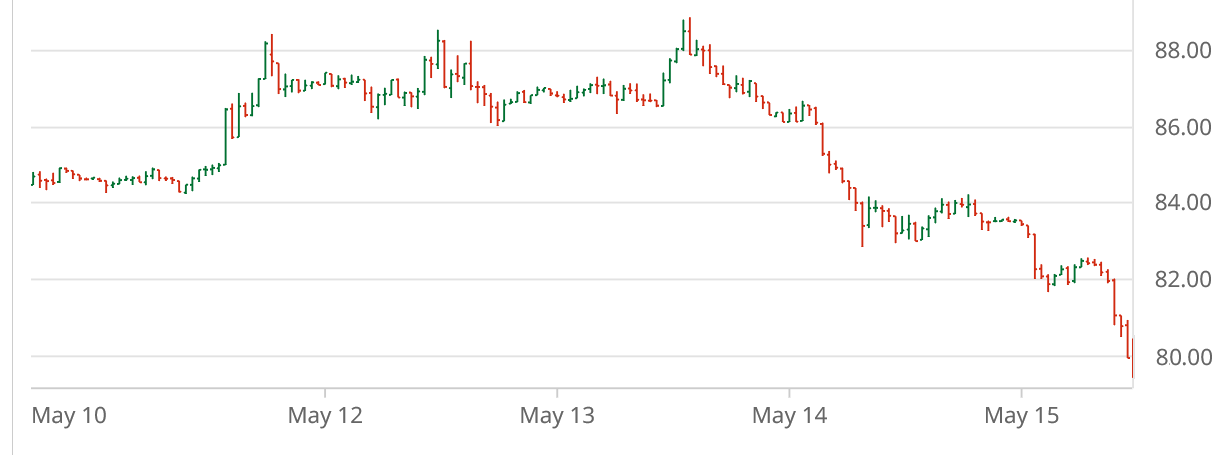
The week ending Friday, May 15 saw ICE cotton futures step higher, trade sideways, and then stumble lower (see Jul’26 chart above courtesy of Barchart.com). The nearby Jul’26 contract settled at 80.61 cents per pound on Friday while the new crop Dec’26 settled at 81.89 cents per pound. Chinese cotton prices crept slightly higher over most of the week ending May 14 while the A-Index of world cotton prices rose more steadily.
Other ag futures markets followed similar paths for the week ending May 14. CBOT corn and soybeans, as well as KC wheat both started the week in an uptrend before falling hard on Thursday — similarly to ICE cotton. Apparently no ag news from the China summit was bad news. ICE WTI rose, paused, and rose more through Thursday, with a lack of resolution to the U.S.-Iran situation. The U.S. dollar index trended higher, then gapped lower before stabilizing through Thursday.
Cotton-focused news this week included neutral supply and demand adjustments to the old crop (i.e., month-over-month) and new crop (year-over-year) cotton balance sheets. The week also saw a seasonally low level of U.S. export net sales as of May 7. Weekly U.S. cotton export shipments slipped a bit to just below USDA’s export target level. Reported demand indicators included inactive to active spot trading, very light to good demand, and light to moderate supplies, all depending on the region.
Through Wednesday, May 13, the daily shifts in ICE cotton open interest were mostly higher compared to the previous day. There appeared to be evidence of net long positioning in the Monday and Wednesday sessions. The regular Tuesday speculative snapshot (represented by the CFTC’s CIT “Supplemental” report for May 12) saw mixed speculative positioning. Specifically, there were 1,367 fewer (liquidated) hedge fund longs, week over week. This was mostly countered by 1,017 fewer (covered) hedge fund shorts compared to last week. Lastly, the index fund net long position shrank by 3,661 contracts, week over week.
The dynamics of ICE cotton futures may also represent a wet blanket on the market, but one that is perhaps lifting. The rising certified stock levels in early 2026, and again in April, could reflect weak commercial demand for U.S. cotton. It remains true that unfixed call sales (representing potential/eventual futures buying by mills) have been at a relatively low level, perhaps reflecting the cautionary buying on the demand side. But more recently, unfixed call sales have been stabilizing/rising (see red line in the chart below). This is bringing them more into balance with unfixed call purchases, and contributing to futures buying.
For more details and data on Old Crop and New Crop fundamentals, plus other near term influences, follow these links (or the drop-down menus above) to those sub-pages.
Πηγή: TAMU